


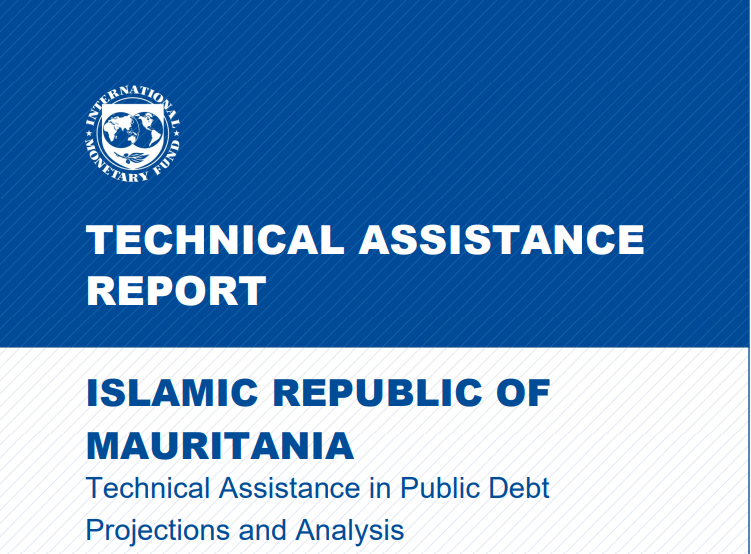
NOUAKCHOTT, Mauritania (XOL Africa) — Mauritania has strengthened its public debt management capabilities following the completion of a multi-year technical assistance programme supported by the International Monetary Fund (IMF) aimed at improving debt analysis, forecasting and policymaking.
The initiative, carried out by Mauritania’s Ministry of Finance in partnership with the IMF’s Institute for Capacity Development (ICD), was financially supported by the Government of Japan. A final technical report published in May 2026 highlighted the progress made in developing analytical tools to help authorities manage economic uncertainty, commodity price fluctuations and climate-related risks.
A key achievement of the programme was the adaptation and implementation of the IMF’s Public Debt Dynamics Tool (DDT) for Mauritania’s National Public Debt Committee (CNDP), the body responsible for coordinating debt policy, assessing sustainability and supporting decision-making across government institutions.
The CNDP brings together officials from the Ministry of Finance, the Ministry of Economy and Sustainable Development, and the Central Bank of Mauritania.
Tailored Tools for Commodity and Climate Risks
To reflect Mauritania’s economic structure, the IMF introduced two customized extensions of the debt analysis framework.
The Resource-Rich Country Adaptation (DDT RRC) allows policymakers to separate volatile extractive revenues from iron ore, gas and gold from underlying fiscal performance by focusing on the non-extractive primary balance.
The Natural Disaster Integration module (ND_DDT) incorporates historical climate events and economic modelling to assess how severe droughts and commodity price shocks could affect future debt levels.
“The adoption of the DDT represents an important milestone in improving Mauritania’s macroeconomic management, especially in addressing challenges to develop consistent debt projections and Medium-Term Debt Strategies,” the IMF report said.
Debt Expected to Decline After Short-Term Increase
The IMF analysis showed that Mauritania’s public debt was projected to rise during 2024 and 2025, mainly due to non-extractive primary deficits.
However, the debt trajectory is expected to decline between 2026 and 2028 as stronger economic growth and increased resource revenues help improve fiscal conditions.
The report noted that recent stabilization in global commodity markets has provided some relief, but Mauritania’s fiscal outlook remains vulnerable to external food and energy price fluctuations, as well as the growing costs of climate adaptation.
IMF Recommends Further Institutional Reforms
To preserve the gains from the technical assistance programme, the IMF recommended that Mauritania integrate DDT-based projections and stress tests into CNDP decision-making processes by December 2026.
The Fund also called for stronger coordination among government institutions through formal workflows, clearly defined responsibilities and reporting timelines.
In addition, the IMF recommended twice-yearly training programmes for new technical staff to maintain institutional knowledge and ensure continuity in debt management operations.
The reforms are expected to provide Mauritanian authorities with stronger tools to design medium-term debt strategies and improve resilience against economic and environmental shocks.
Read the full report here.