


LAGOS, Nigeria (XOL Africa) — The Dangote Petroleum Refinery‘s offshore marine terminal has handled approximately 1,100 tanker calls since beginning operations, with traffic expected to increase significantly as Africa’s largest refinery moves toward full production capacity, a senior company official said.
Captain Satendra Singh Rana, head of Port Infrastructure and Marine Operations at Dangote Petroleum Refinery and Petrochemicals, said the facility currently receives about 75 tanker calls each month and projects annual traffic to rise to between 900 and 1,000 vessel calls as operations expand.
Rana disclosed the figures while hosting participants of the Global CEO Africa Programme from Lagos Business School during a tour of the refinery’s marine infrastructure.
“We are now clocking about 75 tanker calls a month. We are looking to scale to 900 to 1000 tanker calls per year as the refinery is ramped up to full capacity already,” Rana said.
“Today we have clocked approximately 1,100 tanker calls already, changing the energy landscape and maritime economy, bringing Nigeria to the forefront, not only by the refinery but for the maritime trade as well.”
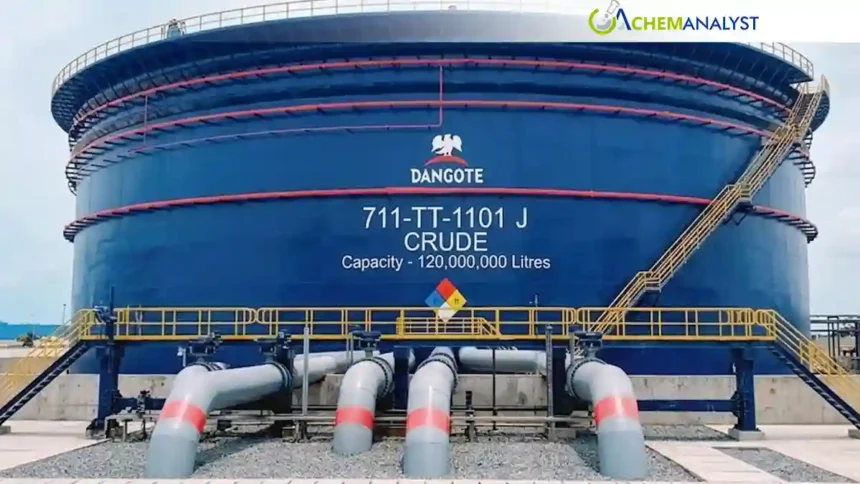
The refinery’s dedicated offshore terminal serves as the hub for importing crude oil and exporting refined petroleum products through an integrated subsea pipeline network, allowing it to receive some of the world’s largest oil tankers without relying on conventional port infrastructure.
Speaking at the refinery’s Landfall Point, also known as the Trestle, Rana said the facility links the refinery’s offshore Single Point Mooring (SPM) terminals with its onshore processing complex.
He explained that crude oil delivered by large tankers is discharged at offshore SPM terminals before being transported through subsea pipelines into storage tanks and processed through crude distillation and other refining units. Refined petroleum products are then pumped through separate pipelines back to the offshore terminals for export or domestic distribution.
The refinery operates five offshore SPM terminals, including two dedicated to crude oil imports and three for loading refined petroleum products, enabling simultaneous import and export operations.
Rana said the offshore loading system was designed to accommodate Very Large Crude Carriers (VLCCs), which require natural water depths of between 21 and 22 meters, eliminating the need for costly dredging typically associated with conventional seaports.
According to him, the largest vessel received at the terminal delivered 3 million barrels of crude oil, while VLCCs carrying about 2 million barrels regularly call at the refinery. Suezmax tankers transporting approximately 1 million barrels also routinely supply crude from domestic and international sources.
He added that the offshore location provides year-round operational reliability because it is not exposed to cyclones, typhoons or other severe weather conditions that can disrupt marine activities elsewhere.
“Ships berth directly at the refinery’s Single Point Mooring terminals, where floating hoses connect them to pipelines anchored to the seabed,” Rana said, noting that the system eliminates the need for ship-to-ship cargo transfers while supporting efficient crude imports and refined product exports.
Participants in the Lagos Business School programme toured the refinery’s marine facilities, processing units, laboratory, main control room, crude storage tanks and loading gantry as part of the visit.
Enase Akinwuntan, Academic Director of the Global CEO Africa Programme at Lagos Business School, said the refinery demonstrates Africa’s capacity to execute large-scale industrial projects using local investment.
“Led by Alhaji Aliko Dangote and funded with local resources, the refinery symbolizes a bold commitment to advancing Africa’s industrial capabilities,” Akinwuntan said.
He said the project extends beyond Nigeria’s downstream petroleum sector, describing it as an example of how private-sector investment can strengthen industrialization and regional trade under the African Continental Free Trade Area (AfCFTA).
Akinwuntan added that refining crude oil domestically while exporting higher-value petroleum products can improve trade balances, reduce dependence on imported fuels and generate additional foreign exchange earnings.
The update comes as the Dangote Petroleum Refinery continues to strengthen its financial position ahead of a planned initial public offering later this year. The company recently raised $2.5 billion through a private placement to support expansion plans and increase production for domestic and export markets.
Nigeria’s National Pension Commission has also granted Pension Fund Administrators a regulatory waiver allowing them to invest pension assets in the planned IPO once it receives the necessary regulatory approvals, making the offering one of the most closely watched transactions in the country’s capital market.