


Nigeria’s oil-rich Bayelsa state has agreed a partnership with US-based Fulcrum LNG to develop gas gathering and processing infrastructure, in a move aimed at commercialising flared gas, expanding electricity generation and attracting industrial investment to the Niger Delta.
The agreement, reached on Thursday at the inaugural US-Nigeria Governors Government-to-Business Forum in Texas, will initially focus on capturing gas currently burned off at oil production facilities and supplying it to Bayelsa’s independent power plant and emerging industrial clusters.
The project will be developed in phases, with an initial gas gathering and commercialisation programme followed by a broader strategy to monetise the state’s substantial natural gas reserves.
The proposed investment could run into billions of dollars, although the companies have yet to determine its scale, financing requirements or technical specifications.
Jesus Bronchalo, chief executive of Fulcrum LNG, said the company would undertake a detailed assessment of gas flare sites across Bayelsa to establish the commercial viability of gathering and processing the gas.
He said Fulcrum was developing a comparable project in Guyana valued at approximately $3bn and suggested that the Bayelsa investment could exceed that amount, depending on the outcome of feasibility studies.
“First, we need to understand the problem on ground — where those facilities are and why gas is being flared,” Bronchalo said.
“Some flares may be so remote or uneconomic that gathering may not be viable. The key question is whether the flaring is due to lack of infrastructure to move the gas or lack of re-injection capacity.”
The company estimates that construction and commissioning could take approximately 12 months after a final investment decision, although no timetable has been announced for completing the preliminary studies or securing that decision.
Gas monetisation and industrial expansion
The partnership reflects growing efforts to turn Nigeria’s underutilised natural gas resources into commercially productive assets as the country seeks to diversify energy supply, reduce industrial operating costs and curb emissions associated with routine gas flaring.
Despite possessing some of Africa’s largest natural gas reserves, Nigeria continues to face infrastructure constraints that limit the collection, processing and transportation of gas from producing fields to domestic consumers and export facilities.
For Bayelsa, the proposed investment could provide an opportunity to develop local gas-based industries while reducing the environmental impact of oil and gas production.
Governor Douye Diri said the state was particularly interested in the project’s potential to address pollution and support industrial development.
“Our interest is how this project will reduce the effects of environmental pollution on our people and boost our industrialisation drive,” Diri said.
The governor called for an accelerated implementation timetable, noting that his administration had approximately 15 months remaining in office.
Bronchalo said Fulcrum’s preferred financing model would involve the company providing the full investment capital, with government participation available through an equity contribution.
“The way we do it, we invest 100 per cent. If government wants equity, then it brings capital for that portion,” he said.
However, the proposed ownership structure, commercial terms and allocation of project risks have not been disclosed.
Bayelsa seeks greater share of Nigeria’s gas economy
Diri said Bayelsa accounted for an estimated 15 to 20 per cent of Nigeria’s proven natural gas reserves and supplied approximately 60 per cent of the gas used by Nigeria LNG at its Bonny Island facilities in neighbouring Rivers state.
The figures, cited by the governor during his presentation to prospective investors, underscore the state’s ambitions to capture more economic value from resources produced within its territory.
Bayelsa has historically been central to Nigeria’s petroleum industry, but inadequate infrastructure and limited industrial processing capacity have constrained opportunities to develop a broader manufacturing base.
Diri also promoted the state’s maritime potential, highlighting its 203-kilometre Atlantic coastline and the proposed Agge Deep Seaport as infrastructure assets capable of supporting international trade and industrial investment.
He described Agge as a natural deepwater port that would require no dredging, although the project’s development and commercial prospects remain dependent on further investment.
US investors explore Nigerian energy opportunities
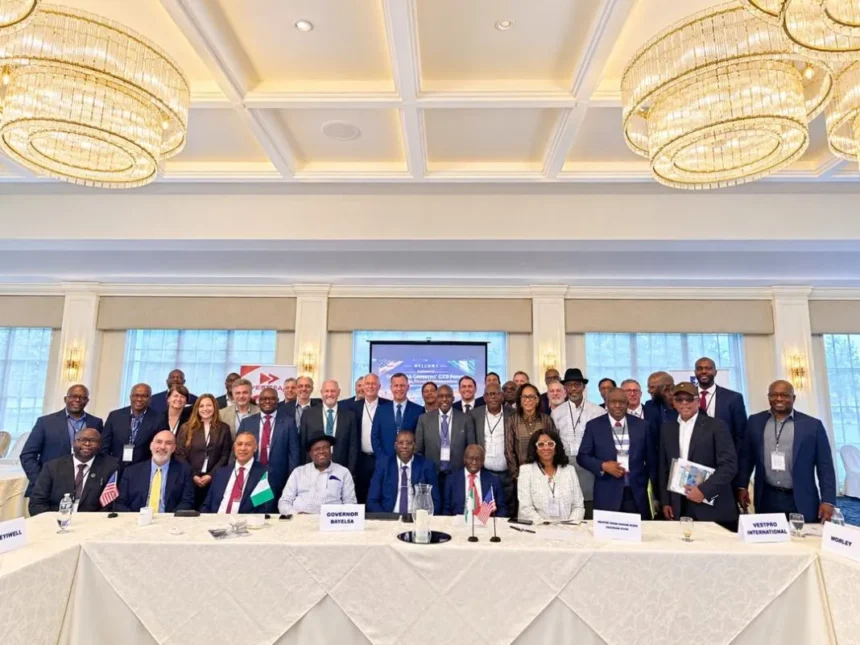
The agreement followed the two-day forum in Sugar Land, Texas, organised by Westpaq International in collaboration with the US Department of Commerce and the US Commercial Service in Houston.
The event brought together representatives from Bayelsa, Nasarawa, Ogun and Ondo states and more than 15 American energy, mining, engineering and financial companies.
Participating companies included Honeywell, KBR, Worley, Lummus Technology and VGas, reflecting interest in opportunities across Nigeria’s energy and infrastructure sectors.
Samuel Diminas, chief executive of Westpaq International, said his organisation would continue coordinating with the parties to facilitate the project’s implementation.
He also acknowledged the involvement of former Nigerian senator Ben Murray-Bruce in supporting the forum.
The Bayelsa agreement comes as Nigeria seeks to attract greater private investment into gas infrastructure, particularly projects capable of converting associated gas that would otherwise be flared into electricity, industrial feedstock and other commercially valuable products.
For Fulcrum, the immediate priority will be determining whether the location, volume and composition of available gas can support an economically viable gathering and processing network.
The project’s ultimate scale will depend on those findings, as well as access to existing oil and gas infrastructure, regulatory approvals and agreements with gas producers and potential buyers.
If implemented, the investment could strengthen Bayelsa’s position in Nigeria’s gas value chain while providing additional electricity and feedstock for industrial development.
The agreement remains at a preliminary stage, however, with no binding investment commitment, final project cost or construction start date disclosed.
SUPPORT AFRICAN BUSINESS JOURNALISM
Help XOL Africa expand independent business reporting across Africa.
SUPPORT XOL AFRICA →