


ACCRA, November 10, 2026 — Ghana is seeking to expand defence and security cooperation with Canada, targeting cybersecurity, artificial intelligence and maritime surveillance as the West African country looks to modernise its military capabilities and respond to growing regional security challenges.
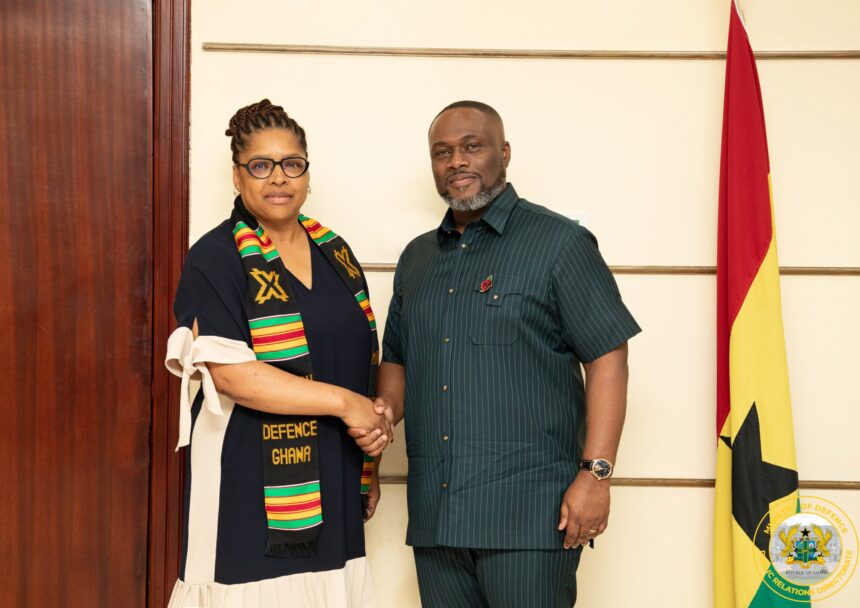
The proposed expansion was discussed during a meeting between Ghana’s Defence Minister, Kenneth Gilbert Adjei, and Canada’s High Commissioner to Ghana, Myriam Montrat, in Accra.
In a statement released on Tuesday, Ghana’s Ministry of Defence said the discussions focused on strengthening bilateral military cooperation, intelligence sharing, training and peace support operations, while identifying emerging technologies as potential areas for future collaboration.
Adjei acknowledged Canada’s longstanding support for the Ghana Armed Forces, particularly in military training, peacekeeping and programmes aimed at increasing women’s participation in United Nations peace operations.
He highlighted the Elsie Initiative for Women in Peace Operations, a Canadian-backed programme designed to address barriers limiting the deployment of uniformed women to UN peacekeeping missions.
The minister said Ghana was prepared to deepen cooperation with Canada to strengthen its military capabilities against internal and external security threats.
Cyber defence, artificial intelligence, maritime security and advanced surveillance technologies were identified as priority areas for future partnerships.
The emphasis on technology reflects the increasing importance of digital infrastructure, intelligence capabilities and maritime monitoring in national security planning.
For Ghana, investment in these capabilities could support efforts to improve military readiness, protect strategic infrastructure and strengthen surveillance of its territorial waters and maritime economic interests.
The discussions also come against a backdrop of security concerns across West Africa, where instability in parts of the Sahel has increased pressure on coastal countries to strengthen border security, intelligence coordination and regional defence cooperation.
Montrat reaffirmed Canada’s commitment to supporting Ghana’s defence institutions and highlighted the contribution of existing bilateral programmes to military capacity building.
She said the Elsie Initiative had helped develop approaches to increasing women’s participation in UN peacekeeping operations, while Ghanaian-Canadian cooperation had also supported the development of gender-related policies addressing sexual abuse.
The Canadian envoy indicated that Ottawa would continue supporting efforts to strengthen Ghana’s defence capabilities and institutional resilience.
Beyond military training and peacekeeping, the proposed areas of cooperation could create opportunities for technical assistance, specialised equipment and knowledge transfer, although no new funding commitments, procurement agreements or implementation timelines were announced.
Both countries also discussed the importance of addressing security threats that increasingly cross national borders, underscoring the need for stronger international coordination.
The meeting concluded with commitments to build on existing defence relations and explore additional areas of cooperation.
For Ghana, closer engagement with Canada could provide access to technical expertise and training as it seeks to modernise its armed forces, while reinforcing its role in regional security and international peacekeeping operations.
SUPPORT AFRICAN BUSINESS JOURNALISM
Help XOL Africa expand independent business reporting across Africa.
SUPPORT XOL AFRICA →