



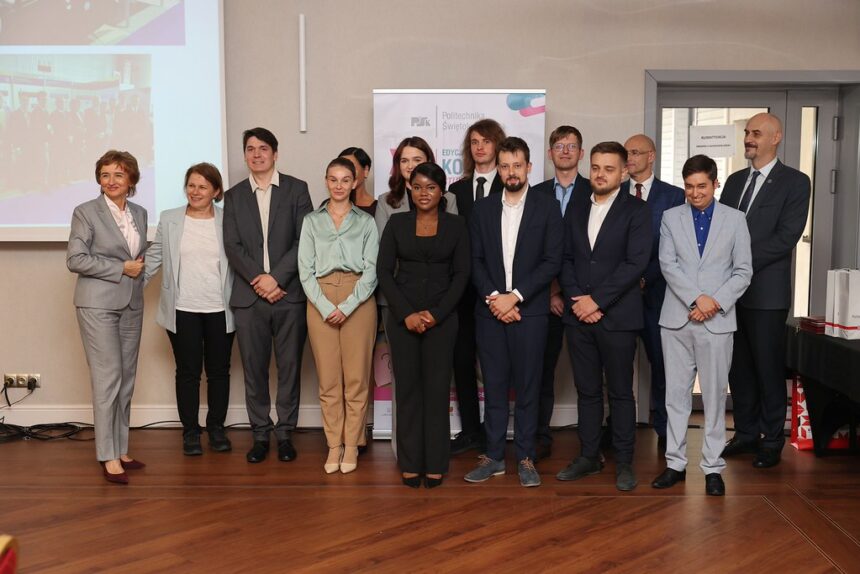
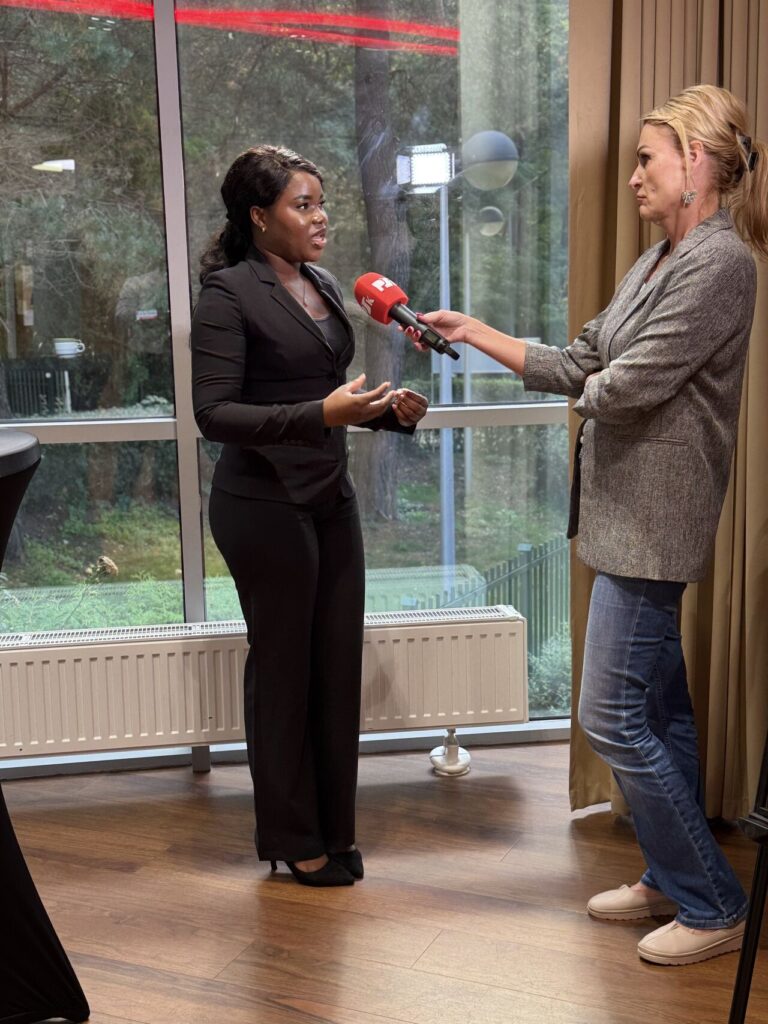
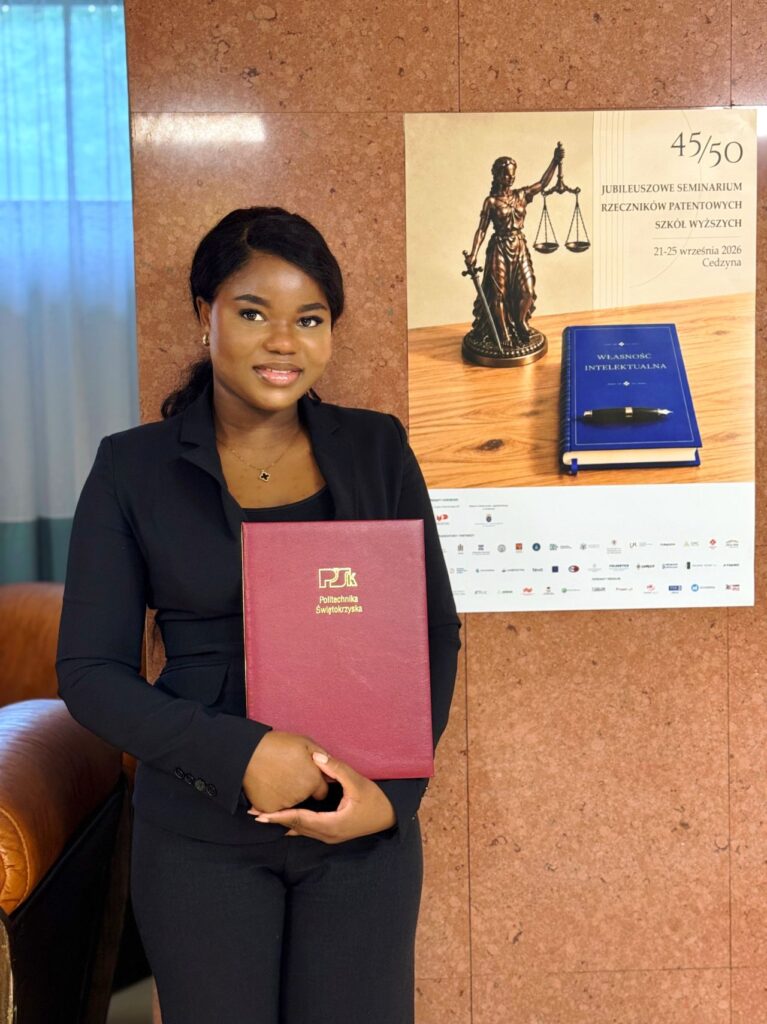
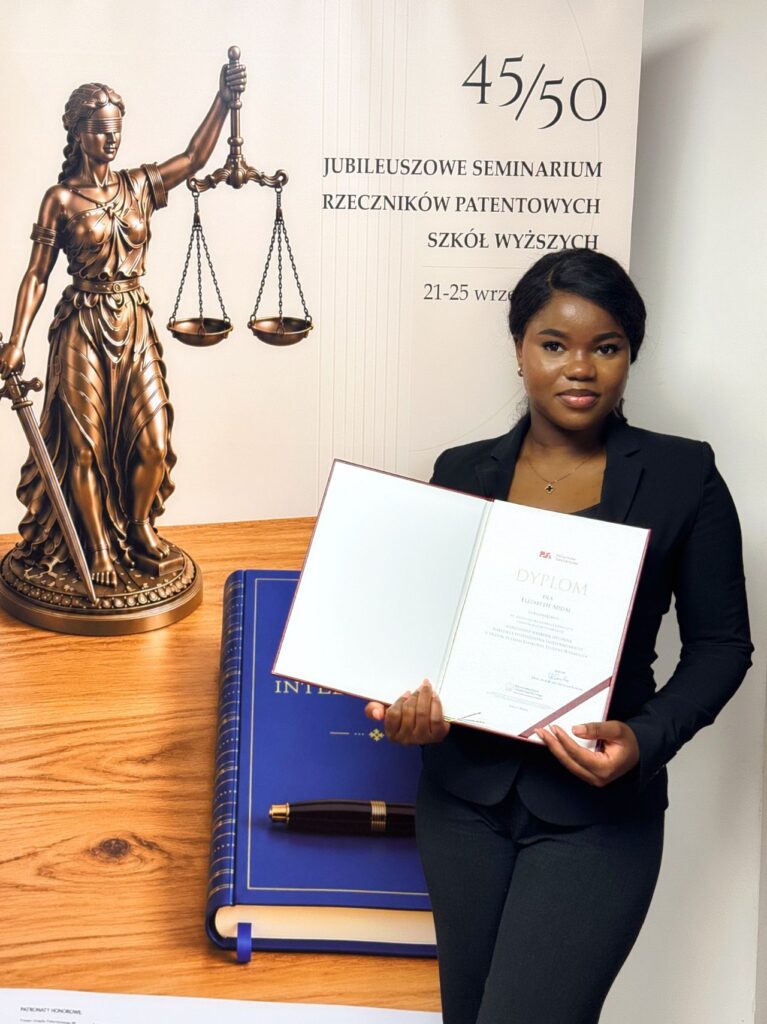
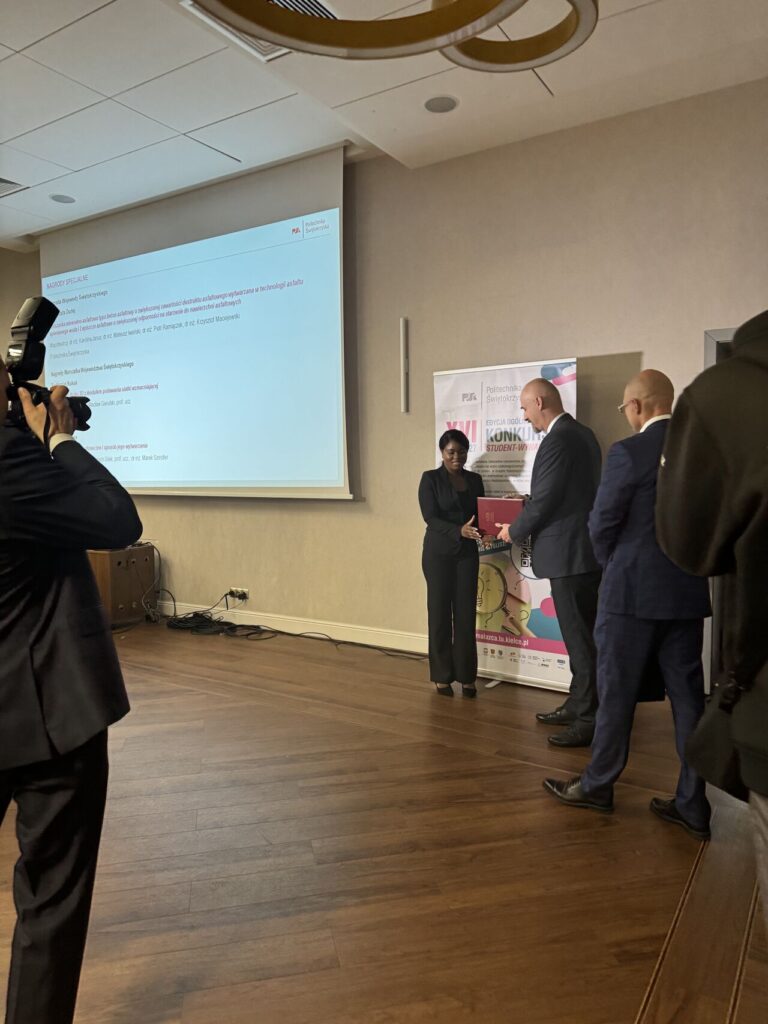
KIELCE, Poland (XOL Africa) — Ghanaian materials researcher Elizabeth Adzo Addae has become the first African to receive an award in Poland’s National Student-Inventor Competition (Ogólnopolski Konkurs Student-Wynalazca), earning a Special Award from the Marshal of the Świętokrzyskie Voivodeship for her invention aimed at improving dye-sensitized solar cells.
Addae, a researcher at Poland’s Silesian University of Technology, was recognized during the 16th edition of the National Student-Inventor Competition in Kielce for her invention, “Dye-Sensitized Solar Cell and Method of Its Manufacturing.”
The competition, organized by the Kielce University of Technology, is aimed at students, doctoral researchers and graduates who have developed inventions or utility and industrial designs protected or submitted for protection.
“I am delighted to share that my invention ‘Dye-Sensitized Solar Cell and Method of Its Manufacturing’ received a Special Award from the Marshal’s Office of the Świętokrzyskie Voivodeship,” Addae said in a statement shared on LinkedIn.
From Ghana to Poland
Addae’s research career in photovoltaic materials began in Ghana. She was a researcher in the Department of Materials Science and Engineering at the University of Ghana, where she worked on research involving solar-cell materials and nanotechnology. Her academic work there included research on nanomaterials for flexible solar-cell applications.
She later continued her research in Poland and is currently affiliated with the Doctoral School at the Silesian University of Technology, with her research discipline listed as materials engineering. Her current research profile identifies her work with the United Nations Sustainable Development Goal of affordable and clean energy.
Her publication record includes research on atomic-layer-deposited nanolayers for dye-sensitized solar cells and, more recently, a 2026 peer-reviewed review examining defect, morphology and interface engineering of titanium dioxide in dye-sensitized solar cells.
Engineering solar cells at the nanoscale
Addae’s award-winning invention focuses on the interfaces within dye-sensitized solar cells, a type of photovoltaic technology that can operate effectively under relatively low-light conditions.
The invention introduces tin oxide (SnO₂) between the transparent conducting oxide and nanocrystalline titanium dioxide. The additional layer is designed to reduce charge-carrier recombination and improve the movement of electrical charge through the device.
The invention also uses aluminium oxide (Al₂O₃) as a protective layer over the adsorbed dye. The layer is intended to limit degradation and improve the long-term stability of the solar cell.
Both layers are deposited using Atomic Layer Deposition (ALD), a technique that allows researchers to create highly uniform coatings with precisely controlled thickness.
The research reflects a broader effort to improve photovoltaic performance by engineering materials and interfaces at the nanoscale. Addae’s research portfolio at the Silesian University of Technology includes several publications on dye-sensitized solar cells, including work examining the effects of ALD-deposited Al₂O₃ nanolayers on the morphology and performance of solar cells.
A 2022 publication from the University of Ghana also lists Addae among researchers in its Department of Materials Science and Engineering working on nanomaterials for flexible solar-cell applications.
African research talent in Europe’s innovation ecosystem
For Ghana and Africa, Addae’s work illustrates the contribution of African-trained researchers to advanced materials science and renewable-energy research in Europe.
Her research connects academic work in Ghana with ongoing research in Poland on photovoltaic materials, nanotechnology and clean-energy technologies.
“By controlling these interfaces more precisely, the technology has the potential to contribute to DSSCs with improved conversion efficiency, stability and operational lifetime,” Addae said.
She credited the Silesian University of Technology and her supervisors, Dr. hab. inż. Wojciech Sitek and Dr. inż. Marek Szindler, for their guidance and support throughout the research.
She also thanked the organizers of the National Student-Inventor Competition and Kielce University of Technology for recognizing the invention and supporting student research, intellectual-property protection and commercialization.
“Receiving this award is both a recognition of the work accomplished so far and motivation to continue exploring how advanced materials, thin-film technologies and nanoscale engineering can contribute to the future of renewable energy,” Addae said.
SUPPORT AFRICAN BUSINESS JOURNALISM
Help XOL Africa expand independent business reporting across Africa.
SUPPORT XOL AFRICA →