



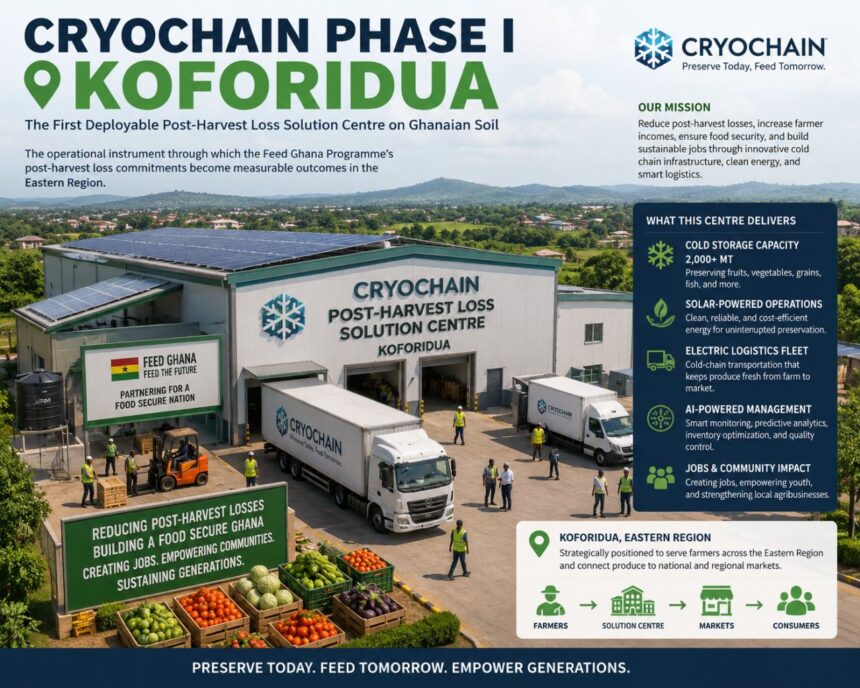
KOFORIDUA, Ghana (XOL Africa) — U.S.-incorporated cold chain and clean energy company CryoChain Inc. and Koforidua Technical University (KTU) are planning to establish a Cold Chain AgriTech and Applied Technology Ecosystem Hub in Ghana’s Eastern Region, a project aimed at reducing post-harvest food losses while training students in advanced agricultural technologies.
The partners said the initiative will combine industry and academia by providing students with hands-on experience operating cold chain infrastructure while supporting food security and agricultural value chains.
The partnership agreement is expected to be finalized in the coming weeks, with groundbreaking for the first phase targeted for the fourth quarter of 2026.
The project comes as Ghana continues to grapple with significant post-harvest losses. According to CryoChain, about half of the country’s food is lost before reaching consumers, with fruits and vegetables accounting for some of the highest losses, representing an estimated economic cost of nearly $1.9 billion annually.
Across sub-Saharan Africa, post-harvest losses exceed 30% of crop production and are valued at more than $4 billion each year, the company said.
CryoChain said the hub will also capitalize on Africa’s growing technology workforce by integrating software development, engineering and agricultural innovation into a single ecosystem.
The company cited industry data indicating that Africa has one of the world’s fastest-growing software developer communities, with Ghana alone home to tens of thousands of professional software engineers.
Will McCoy II, co-founder and chief executive officer of CryoChain, compared the initiative to the collaboration between Stanford University and Hewlett-Packard that helped give rise to Silicon Valley.
“HP and Stanford proved that when you place industry beside a university and let talent build, you create an entire ecosystem, not just a single company,” McCoy said.
“Silicon Valley began as farmland. We are starting with the farms and building the technology around them. KTU is our Stanford, Koforidua is our Palo Alto, and we intend to grow Africa’s Agric Valley right here.”
McCoy said the project is intended to attract entrepreneurs, technology companies and investors seeking opportunities in Africa’s growing digital and agricultural sectors.
“I want the diaspora founders who have been waiting for a sign, the investors still on the fence about Africa, and the companies shaping the future, like NVIDIA, Google, Microsoft and Anthropic, to look closely at what is happening here,” he said.
“The talent is world-class, the cost to build is a fraction of what it is at home, and the markets are wide open. We are proving it in Koforidua. Come build with us.”
The project aligns with Ghana’s efforts to strengthen agro-processing and cold chain infrastructure as part of its 24-Hour Economy Programme, which seeks to boost industrialization, create jobs and reduce food waste.
CryoChain said its integrated model combines cold storage, agricultural processing, clean energy and logistics to reduce post-harvest losses while creating employment opportunities and strengthening food security.
The company plans to anchor the first phase of the project in Koforidua before expanding the model to other locations.
SUPPORT AFRICAN BUSINESS JOURNALISM
Help XOL Africa expand independent business reporting across Africa.
SUPPORT XOL AFRICA →