


In drought-hit Afar and Oromia, an African Development Bank-backed project is combining climate-smart agriculture, women’s enterprises and local finance in an attempt to turn adaptation into an economic asset.
In Ethiopia’s drought-prone lowlands, climate resilience is increasingly being treated as an economic question as much as an environmental one.
Across parts of the Afar and Oromia regions, pastoralist communities that have faced repeated drought, declining pasture and livestock losses are experimenting with a different model: putting women and young people at the centre of agricultural production, local enterprise and decisions about how communities respond to climate shocks.
The shift is being supported by the African Development Bank Group through grant financing from its Africa Climate Change Fund, under a project focused on gender transformation and climate resilience in the two regions. The programme is being implemented by Farm Africa together with the Population, Health and Environment Ethiopia and UEWCA$ (PHE EC).
The project combines climate-smart farming, solar-powered irrigation, livestock diversification and access to finance through Village Savings and Loans Associations. Its premise is that adaptation is more durable when households have the income, skills and decision-making power to withstand the next drought.
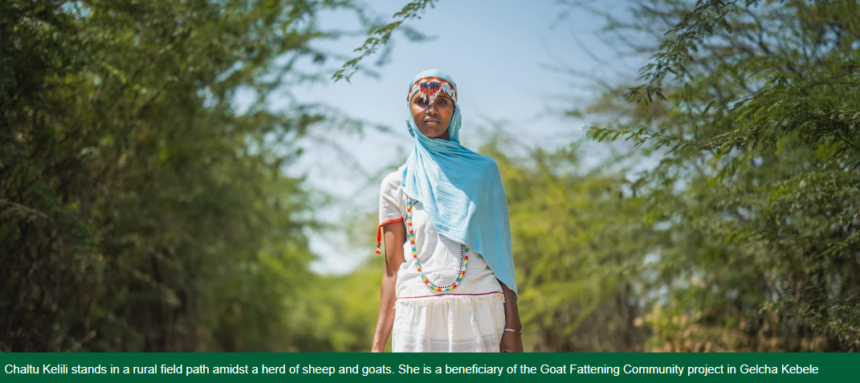
For Chaltu Kelili, a beneficiary of a goat-fattening cooperative in Gelcha Kebele, the difference is already visible in a small but consequential change in household assets.
“Life was very difficult. We relied on farming and livestock, but climate change brought drought, reduced pasture, and more animal diseases,” Kelili said. After joining the women’s cooperative, she received training and 22 goats. “Working together, we increased our herd from 22 to 25 goats. That gave us confidence that we could succeed.”
The increase is modest by conventional investment standards. But in communities where drought can quickly erode livestock holdings and household income, the project is betting that incremental gains in productive assets can strengthen resilience over time.
From climate vulnerability to enterprise
The project’s focus extends beyond livestock. In Oromia, women are being trained to operate dairy-processing equipment, while farmers are using solar irrigation to cultivate land that was previously vulnerable to unreliable rainfall.
Kemisa Roba, who described herself as unemployed and a full-time stay-at-home mother before the project, said the training had changed her economic position.
“Now, all of that is in the past, and I am taking care of myself and my children,” Roba said. “Since we received training, we are using various machines to process and produce milk. We have big plan for the future.”
The economic logic is important for climate adaptation. Rather than treating communities solely as recipients of humanitarian support after droughts, the programme is attempting to create productive capacity before the next shock arrives.
For farmer Chali Ahmado, that has meant repeatedly preparing land for cultivation despite difficult rainfall conditions.
“Even when it rains repeatedly, we prepare the land by plowing it again and again, even before the rain stops, to get it ready for planting,” Ahmado said. “However, we are grateful for the yields we have started to get from it.”
Keeping young people in rural economies
Youth employment is another part of the adaptation strategy.
In many drought-affected rural economies, the absence of reliable income during dry seasons can accelerate migration towards towns and cities. The project is seeking to create alternatives by giving young people practical skills in irrigation and agricultural processing.
Shewit Emmanuel, Farm Africa’s country director in Ethiopia, said the intervention was intended to address that economic pressure directly.
“Before the project intervention, many young people felt forced to leave our villages because there were no local economic opportunities during dry seasons,” Emmanuel said. “Learning to manage solar irrigation systems and process agricultural goods gave us a reason to stay and build our future right here in our community.”
That approach reflects a broader shift in development finance towards adaptation projects that combine physical climate infrastructure with household-level economic resilience.
Gender equality becomes an economic intervention
The programme is also attempting to change household decision-making and social expectations around women’s economic roles.
As women become more involved in cooperatives and enterprises, the African Development Bank says traditional attitudes towards gender roles are beginning to change, with some male community members and traditional leaders supporting greater equality in household decisions and girls’ education.
Hussen, a community elder and beneficiary of the solar irrigation programme, described the change in explicitly social terms.
“Because of this project, I have become a stronger believer in gender equality,” he said. “As a father of three daughters, knowing that when my children grow up, our culture respects and cares for them makes me proud to be a father of daughters.”
The project has extended that approach into schools through Gender and Climate Clubs. The clubs address environmental stewardship alongside issues including menstrual health, with sanitary products intended to reduce school absenteeism among girls.
For Fatuma Yasin, a 13-year-old member of one of the clubs in Afar, the programme has connected climate and gender issues with longer-term aspirations.
“It has shown our community that girls are just as capable as boys,” Fatuma said. “Now I know that my future is my choice—I want to become a scientist so I can help solve problems in my community.”
The bigger test: whether adaptation finance can scale
For climate financiers, however, the significance of the Ethiopian programme extends beyond the individual communities involved.
Adaptation has historically been harder to finance and measure than projects aimed at cutting greenhouse gas emissions. Investments in social institutions, women’s decision-making power or household resilience can produce significant economic benefits but are less straightforward to quantify than a solar plant or a reduction in tonnes of carbon dioxide.
The African Development Bank argues that projects such as this one can help broaden the definition of what climate finance can achieve.
Rita Effah, coordinator of the Africa Climate Change Fund, said the model could be relevant in other arid and semi-arid regions where women face social and economic barriers.
“Integrating women into decision-making and climate action yields measurable impacts,” Effah said. “Where women are resourced everywhere, we know that they are able to ensure positive impacts on their households and the community in general.”
The potential prize is therefore larger than the individual goats, irrigation systems or dairy machines supplied through the project.
If the approach can demonstrate that women-led enterprises, agricultural productivity and community decision-making improve the ability of households to withstand climate shocks, it could offer development financiers a template for investing in resilience across Africa’s drylands.
The African Development Bank describes the initiative as a potentially scalable model for other arid and semi-arid regions where pastoral communities remain particularly exposed to climate change.
For Ethiopia’s drought-prone communities, the immediate calculation is more practical: whether the next dry season finds households with more productive assets, better access to water and finance, and a greater say over their own economic future.
The longer-term investment case is whether those gains can survive beyond the project itself.
Source: African Development Bank Group, “Ethiopia: A Gender-transformative Climate Resilience Project Builds Resilient Communities,” published September 9 2026.
SUPPORT AFRICAN BUSINESS JOURNALISM
Help XOL Africa expand independent business reporting across Africa.
SUPPORT XOL AFRICA →