



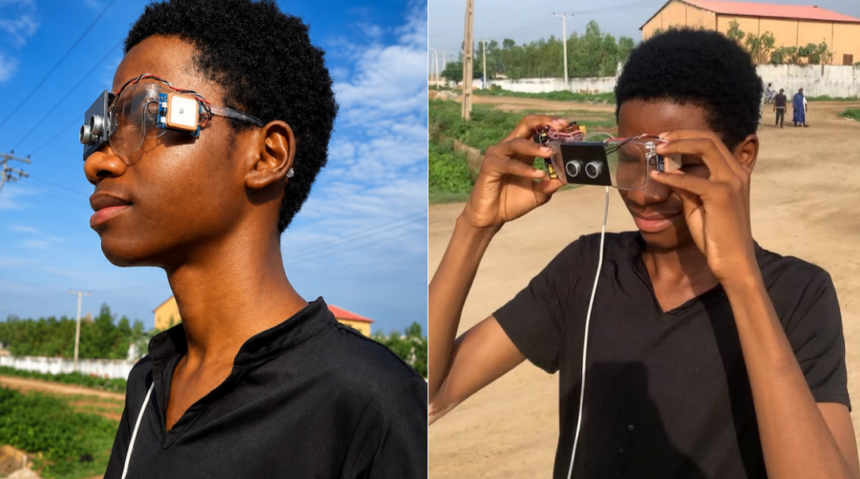
KANO, Nigeria (XOL Africa) — Young Nigerian inventor Khalifa Aminu has unveiled Glass V2, a second-generation pair of sensory glasses designed to help visually impaired people detect obstacles and navigate their surroundings more independently.
The 20-year-old inventor from Kano said the latest prototype builds on the device that first drew international attention to his work in 2024. Glass V2 incorporates artificial intelligence and enhanced tracking capabilities as Aminu continues developing electronic systems aimed at solving practical problems.
The project began around 2023 after Aminu observed the mobility challenges faced by visually impaired people in his community.
“I wanted to create something that could help people who cannot see move around with more confidence and independence,” Aminu said.
His original prototype used ultrasonic and infrared sensors to detect obstacles and alert the wearer through sound. Aminu built the device largely with materials available locally and without access to formal engineering facilities or substantial institutional funding.
He later tested the glasses with a visually impaired man in his community. Feedback from that testing led him to consider improvements such as smaller components, a wireless switch and more effective alerts.
Glass V2 represents a further attempt to address those limitations through artificial intelligence and improved tracking. However, details of the system’s complete specifications, independent testing and projected production costs have not been publicly documented by established scientific or technology publications.
Aminu has also worked on other experimental technologies, including a radio transmitter and agricultural spraying equipment. In July, he demonstrated what he calls a Smart AI Tracking System, which combines GPS, mobile connectivity and artificial intelligence.
His work attracted the attention of Nigeria’s National Commission for Persons with Disabilities, which invited him to Abuja in 2024 to demonstrate his technology and indicated an interest in supporting its assessment and development.
The commission has sought to encourage locally produced assistive technologies, which could help address the cost and availability challenges associated with imported equipment.
Aminu has also received private backing. The Kano Patriotic Front provided equipment, a laptop, workspace support and sponsorship for his education and further inventions. He has also met former Nigerian Communications and Digital Economy Minister Isa Ali Ibrahim Pantami to present his work and seek mentorship.
For Aminu, the next challenge is turning a prototype into a dependable assistive device.
That will require extensive testing with visually impaired users, reliable obstacle detection in different environments, comfortable hardware, dependable battery performance and engineering validation. Certification and a manufacturing process capable of producing the glasses at an affordable price would also be necessary before widespread use.
“Building the prototype is only one part of the journey,” Aminu said. “The goal is to keep improving it until it becomes something people can use reliably in their everyday lives.”
Nigeria has a growing need for affordable assistive technologies, particularly as imported electronic devices can carry high purchase and maintenance costs. Locally developed systems could potentially reduce some of those barriers, but only if they can meet the safety, reliability and performance standards required for everyday use.
Aminu said he is seeking additional financial and technical support to continue refining Glass V2 and his other inventions.
Two years after his original sensory glasses attracted attention beyond Nigeria, the new prototype marks another step in his effort to turn a locally developed idea into an assistive technology with broader applications.
For now, Glass V2 remains a prototype. Its path to wider adoption will depend on further testing, independent validation, affordable manufacturing and sustained support for the young inventor’s work.
SUPPORT AFRICAN BUSINESS JOURNALISM
Help XOL Africa expand independent business reporting across Africa.
SUPPORT XOL AFRICA →