


PRETORIA, South Africa (XOL Africa) — South Africa and Namibia have agreed to deepen economic cooperation, strengthen cross-border trade and pursue joint industrial development as the two neighboring countries seek to turn their longstanding political ties into tangible economic benefits.
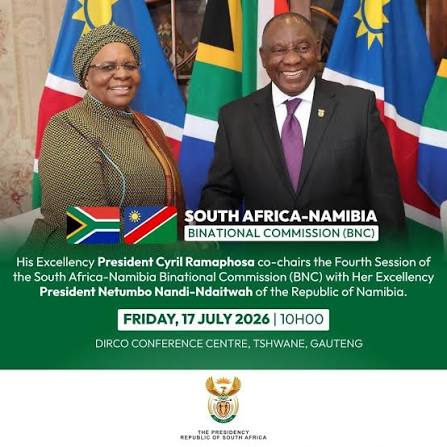
The commitment was made Friday during the fourth session of the South Africa-Namibia Bi-National Commission, co-chaired by South African President Cyril Ramaphosa and Namibian President Netumbo Nandi-Ndaitwah in Pretoria.
The two leaders reviewed bilateral relations and regional and international developments, reaffirming their commitment to cooperation within the Southern African Development Community, the African Union and other multilateral forums.
They also stressed the need to accelerate the implementation of regional initiatives, including the SADC Regional Indicative Strategic Development Plan, the African Union’s Agenda 2063 and the African Continental Free Trade Area.
The leaders said future bilateral cooperation should focus increasingly on “measurable programmes and projects” capable of generating tangible economic and development benefits for citizens of both countries.
Recognizing the countries’ geographical proximity, economic interdependence and complementary resources, Ramaphosa and Nandi-Ndaitwah agreed to promote trade and investment, strengthen cross-border value chains, facilitate private-sector partnerships and pursue opportunities for joint industrial development and beneficiation.
The two countries also welcomed cooperation in mining, petroleum and natural gas and agreed to explore greater collaboration across mineral and energy value chains.
The leaders highlighted the importance of skills development, research, technology, local value addition and beneficiation in supporting industrialization, economic diversification, energy security and job creation.
Energy cooperation was also identified as a strategic priority, with the two sides agreeing to deepen collaboration in electricity generation and transmission, renewable energy and regional energy security, including by accelerating implementation of the Kudu Gas Power Project.
The countries further reaffirmed their commitment to improving transport and logistics links, including the Trans-Kalahari Corridor, to facilitate the movement of goods and people between the two countries and across the wider Southern African region.
Cooperation in water management, agriculture, food security, public health, skills development and public-sector capacity building was also emphasized.
The two governments welcomed the signing of seven bilateral agreements and instruments covering employment and labor, public-sector capacity building, air services, legal cooperation, correctional services, business cooperation and gender equality and women’s empowerment.
The agreements included a Bilateral Air Services Agreement and a memorandum of understanding on cooperation in the legal field, as well as an agreement between the Namibia Chamber of Commerce and Industry and the South Africa Chamber of Commerce and Industry aimed at strengthening economic partnerships.
The leaders also welcomed the South Africa-Namibia Business Forum held Friday, describing it as a strategic public-private partnership platform designed to promote greater economic cooperation between the two countries.
The presidents directed their respective ministries, departments and agencies to develop implementation plans with clear responsibilities and timelines for decisions and agreements reached during the commission’s fourth session.
Senior officials will monitor progress and use a mid-term review mechanism to assess implementation, address obstacles and ensure accountability for commitments, according to the joint communiqué.
Namibia also expressed support for South Africa as it prepares to host the 46th Ordinary Summit of SADC Heads of State and Government in August 2026.
Nandi-Ndaitwah thanked South Africa for the hospitality extended to the Namibian delegation and invited Ramaphosa to Namibia to co-chair the fifth session of the Bi-National Commission.
Ramaphosa accepted the invitation, with the date of the next session to be agreed upon by the two governments.
SUPPORT AFRICAN BUSINESS JOURNALISM
Help XOL Africa expand independent business reporting across Africa.
SUPPORT XOL AFRICA →