


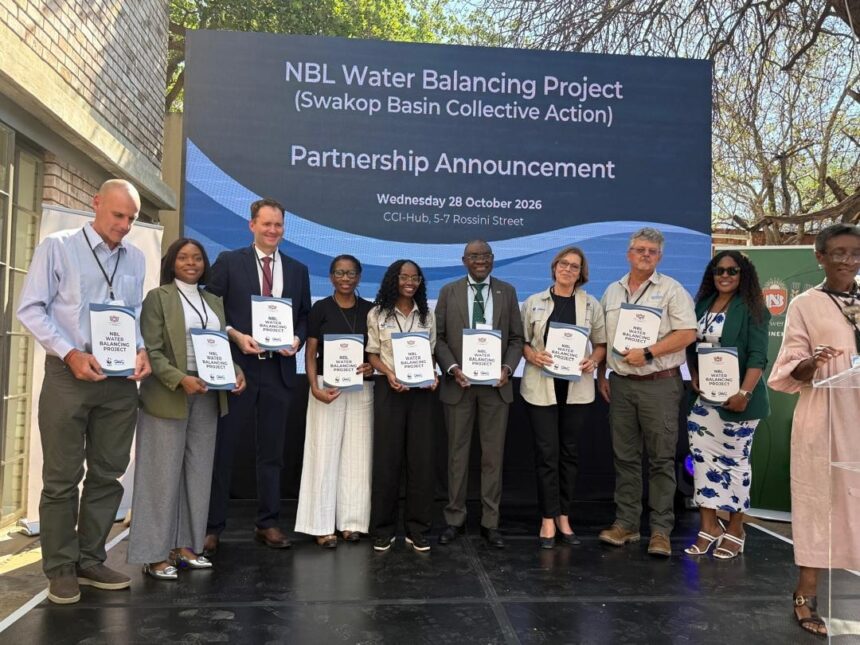
WINDHOEK, Namibia, Nov. 4, 2026 (XOL Africa) — Namibia Breweries Limited has committed N$13mn to a five-year water security initiative in partnership with WWF Namibia and Global Water Challenge, as one of southern Africa’s driest countries seeks to protect critical water resources from rising demand, recurring droughts and climate change.
In a statement announcing the agreement, the companies said the Swakop Basin Collective Action Project, also known as the NBL Water Balancing Project, would run from 2026 to 2030 and aim to improve water availability, groundwater recharge and environmental resilience across the Swakop River Basin.
The initiative will be implemented by WWF Namibia in partnership with Global Water Challenge and the City of Windhoek, drawing on the municipality’s experience in water reclamation and resource management.
The Swakop River Basin is an important source of water for communities, agriculture, industry and urban settlements across central Namibia. Increasing consumption and prolonged periods of drought have placed additional pressure on the region’s limited freshwater supplies.
The investment represents an effort by Namibia Breweries, part of Dutch brewing group Heineken, to extend its water conservation activities beyond its production facilities and into the wider catchment that supports local communities and businesses.
Waldemar von Lieres, managing director of Namibia Breweries, said the company had invested more than N$35mn since 2015 to reduce water consumption across its operations.
“Our ambition is to lead by example in water stewardship, inside our brewery and beyond,” von Lieres said.
“Our N$13 million commitment over five years to the Water Balancing Project extends that investment into the shared basin on which we all depend.”
The brewer said its water efficiency reached 3.56 litres of water for every litre of product manufactured in 2025, with a target of reducing the ratio to 2.4 litres by 2030 under its Brew a Better Namibia strategy.
The company also reported a 30 per cent improvement in water efficiency since 2024.
The project is expected to generate approximately 386mn litres in annual water benefits by 2030 through interventions in the upper Swakop catchment, according to the partners.
That volume is equivalent to more than 150 Olympic-sized swimming pools, although the projected benefits will depend on the effectiveness of the planned interventions.
The measures include managed aquifer recharge, which seeks to replenish underground water reserves, and nature-based solutions designed to improve groundwater quality and availability.
Other activities will involve removing invasive alien plants from riverbeds, restoring degraded land and strengthening the governance of water extraction and allocation.
The partnership plans to restore or improve the management of 153 hectares of land and develop a Sub-Basin Water Allocation and Abstraction Plan to support more sustainable use of the basin’s resources.
The initiative comes as water security becomes an increasingly important economic concern for Namibia, where scarce rainfall and high evaporation rates create challenges for households, agricultural producers and industrial operators.
Water availability is also an important consideration for businesses planning long-term investment in the country, particularly those dependent on reliable supplies for manufacturing and other water-intensive activities.
Teofilus Nghitila, executive director of Namibia’s Ministry of Agriculture, Fisheries, Water and Land Reform, said partnerships involving the government, private sector and conservation organisations would be important in addressing the country’s water challenges.
“The Government of Namibia remains committed to strengthening water security and climate resilience through sustainable water resource management,” Nghitila said.
“Initiatives such as the Swakop Basin Collective Action Project demonstrate the value of partnerships in addressing shared water challenges.”
The project forms part of Heineken’s wider Brew a Better World sustainability strategy, which includes efforts to balance water used in products manufactured in water-stressed areas.
For Namibia Breweries, the investment also reflects growing pressure on industrial companies to account for their environmental impact beyond factory operations, particularly in regions where water scarcity can affect both commercial production and surrounding communities.
Global Water Challenge said the initiative would build on its existing work with WWF Namibia and Coca-Cola in the Swakop Basin, expanding cooperation among companies that depend on the same water resources.
Malick Keita, senior water stewardship director at Global Water Challenge, said collective action was necessary to address challenges that individual companies could not resolve independently.
“Water security is a shared responsibility that requires collective action,” Keita said.
He added that private-sector investment, local expertise and public-sector collaboration could deliver measurable improvements in water availability and ecosystem health.
WWF Namibia said the programme would also seek to strengthen the natural systems that regulate water flows and support biodiversity.
Juliane Zeidler, WWF Namibia’s country director, said protecting the basin’s ecosystems was essential to ensuring the long-term sustainability of water supplies.
“Water touches every aspect of our lives, from the health of our ecosystems to the wellbeing of our communities and economy,” Zeidler said.
“By investing in the health of the basin today, we have an opportunity to address water challenges at their source and create lasting benefits for people and nature for generations to come.”
The project illustrates the growing role of corporate investment in addressing climate-related infrastructure and resource challenges across Africa, particularly where public funding alone may be insufficient to meet long-term adaptation needs.
However, the partners did not disclose a detailed annual spending schedule or specify how the projected water benefits would be independently verified.
Namibia Breweries, which is listed on the Namibian Stock Exchange and has operated since 1920, said the initiative would contribute to its broader sustainability commitments while supporting economic activity and community resilience.
The programme’s progress will be measured against its 2030 targets for water benefits, land restoration and improved catchment management.
For Namibia, the success of the partnership could provide a model for cooperation between government, conservation groups and water-intensive industries seeking to manage increasingly scarce natural resources while sustaining economic growth.
SUPPORT AFRICAN BUSINESS JOURNALISM
Help XOL Africa expand independent business reporting across Africa.
SUPPORT XOL AFRICA →