



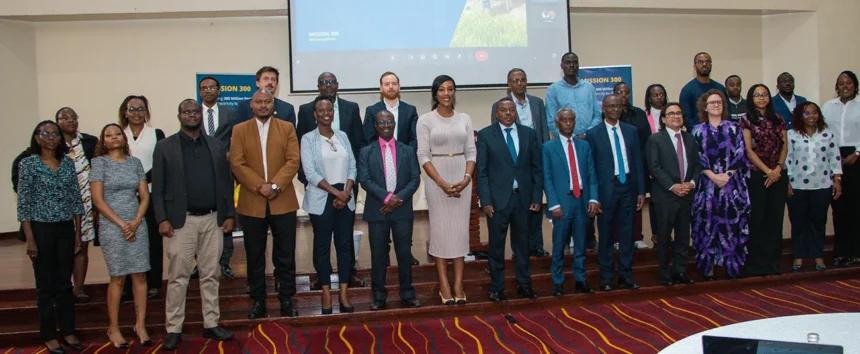
NAIROBI, Kenya (XOL Africa) — Kenya is stepping up efforts to achieve universal electricity access by 2030 under its Mission 300 National Energy Compact, with government agencies and development partners working to turn the country’s commitments into a detailed implementation roadmap.
The government and the African Development Bank Group held a two-day Compact Implementation Support Workshop on July 8-9, facilitated by Sustainable Energy for All, or SEforALL, to coordinate efforts around the delivery of the National Energy Compact.
Kenya’s compact aims to increase electricity access from 75% to 100%, achieve universal access to clean cooking, raise renewable energy capacity from 2,627 megawatts to 5,952 megawatts, develop an additional 8,000 kilometers of transmission lines and attract greater private sector investment in the energy sector.
Mission 300 is a joint initiative of the African Development Bank Group and the World Bank Group, alongside the Rockefeller Foundation, SEforALL and the Global Energy Alliance for People and Planet. The initiative seeks to connect an additional 300 million people to electricity across Africa by 2030.
The workshop brought together Kenya’s Compact Delivery and Monitoring Unit, government institutions, development partners and private-sector representatives to assess reform actions, implementation challenges, financing requirements, monitoring systems and technical assistance needs.
Participants also reviewed Kenya’s project pipeline and laid the groundwork for a 12-month implementation plan.
The workshop, supported by the African Development Bank Group’s Africa Energy Sector Technical Assistance Program, focused on developing Kenya’s Compact Implementation Support Document, a country-owned framework intended to translate the National Energy Compact’s commitments into priority reforms, institutional responsibilities, financing and technical assistance requirements, monitoring arrangements, risk mitigation measures and a sequenced 12-month workplan.
“Kenya has made significant strides in expanding energy access and through the National Energy Compact we have outlined our commitment towards universal access,” Isaac Kiva, secretary for renewable energy at Kenya’s Ministry of Energy and Petroleum, said.
“Through the Compact Implementation Support Document, we have outlined a sequenced roadmap of reforms, investments, coordination arrangements and monitoring that will translate our National Energy Compact into an implementable plan owned by the Compact Delivery Secretariat that will oversee its operationalisation.”
“The success of Mission 300 will be measured not only by the commitments we make, but by the results we deliver,” Wale Shonibare, African Development Bank Group director for energy financial solutions, said.
“This workshop marks an important step in translating Kenya’s National Energy Compact into a practical implementation roadmap with clear priorities, responsibilities and partnerships,” Shonibare said.
“The African Development Bank is proud to support this process and will continue working with the Government of Kenya and our partners to accelerate reforms, unlock investment and deliver sustainable energy access.”
Kenya has made progress since launching its National Energy Compact in 2025, including the launch of transaction advisory services for major hydropower and transmission projects, technical assistance for competitive solar and wind energy auctions, and the establishment of a country platform aimed at turning development priorities into investable projects.
The workshop identified 10 priority reform actions considered critical to accelerating implementation of the compact. The reforms are intended to attract investment, strengthen the policy and regulatory environment and speed up progress toward universal energy access.
Kenya’s workshop is the first in a planned series of Mission 300 national implementation workshops that will also be held in Sierra Leone, Ghana, Senegal, Côte d’Ivoire and Botswana.