


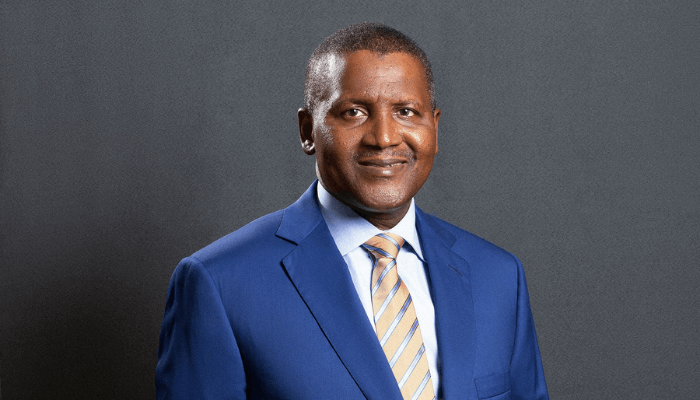
Nigerian billionaire Aliko Dangote has raised his group’s planned investment in Africa to $70bn from $50bn, outlining an ambitious expansion into electricity generation as the continent’s largest economy struggles with chronic power shortages and weak industrial infrastructure.
Dangote, president and chief executive of Dangote Industries Limited, said the revised investment target formed part of the conglomerate’s Vision 2030 strategy, which aims to expand manufacturing capacity, strengthen infrastructure and accelerate industrial development across Africa.
Speaking on Thursday during a visit by northern Nigerian creative industry stakeholders to the group’s refinery and fertiliser facilities in Lekki, Lagos, Dangote disclosed plans for a separate 10,000-megawatt electricity generation programme across Africa, potentially including Nigeria.
“We initially planned to invest $50 billion. We are now looking at increasing that to about $70 billion in Africa,” Dangote said.
The proposed power investment would mark a significant expansion of the group’s infrastructure ambitions beyond its existing manufacturing, petrochemicals and energy operations.
Dangote said the conglomerate currently generates almost 1,500MW of electricity for its own industrial facilities, with plans to increase that capacity to between 4,500MW and 5,000MW by 2030.
“Across the group, we currently have almost 1,500 megawatts. By the time we complete Vision 2030, that could rise to between 4,500 and 5,000 megawatts,” he said.
“That is captive power — electricity for our own operations. Separately, part of the vision is to intervene in power generation with 10,000 megawatts across Africa, potentially including Nigeria.”
The distinction between captive generation and electricity supplied to wider markets is significant. While Dangote’s existing power infrastructure primarily supports its industrial operations, the proposed 10,000MW programme could extend the group’s influence into electricity supply beyond its factories.
However, Dangote did not provide a detailed financing structure, project locations or implementation timetable for the proposed programme.
Electricity shortages constrain industrial growth
Nigeria’s unreliable electricity supply remains one of the biggest structural obstacles to industrialisation, forcing manufacturers and smaller businesses to rely heavily on expensive diesel and petrol generators.
Dangote argued that the resulting operating costs were undermining the competitiveness of small and medium-sized enterprises, which account for a substantial share of economic activity.
“A vibrant economy is driven by small and medium-sized enterprises. Large companies such as ours help sustain those businesses, but SMEs are essential to economic activity,” he said.
“When you generate electricity using diesel or petrol, it becomes very difficult to make money.”
He cautioned that private investments in alternative electricity sources, including solar installations, could not substitute for broader improvements in national power infrastructure.
“Installing solar power for yourself does not mean the wider problem has been solved. Other people may not have that option,” he said.
The comments highlight the wider challenge confronting African industrial development: the need to expand electricity generation alongside transmission networks, distribution infrastructure and commercially sustainable power markets.
Manufacturing and value addition drive expansion
Beyond electricity, Dangote identified agriculture, solid minerals and industrial processing as priorities for Africa’s economic transformation.
He argued that African economies needed to reduce their dependence on exporting unprocessed commodities and importing higher-value manufactured products.
“We should not simply export raw materials and then buy back the processed products at many times the price. That is the pattern we want to change,” he said.
“Without production, we will continue to face economic difficulties. We must build a productive economy.”
The strategy reflects the business model that has underpinned Dangote Industries’ expansion from commodity trading into cement, fertiliser, petroleum refining and other manufacturing activities.
Its industrial investments, including the Dangote Petroleum Refinery in Lagos, represent an effort to capture more value from Africa’s natural resources while reducing reliance on imported finished products.
Dangote said further investment in transport infrastructure, particularly ports, would be necessary to improve market access and support manufacturers seeking to export goods.
He also pointed to northern Nigeria’s agricultural and mineral resources as opportunities for industrial investment and local processing.
Policy stability remains critical
Despite the group’s expansion ambitions, Dangote warned that inconsistent government policies and inadequate infrastructure continued to discourage private investment.
He argued that governments should prioritise regulatory certainty and business-friendly policies while allowing private enterprises to drive production and employment.
“Government’s principal responsibility is to create an enabling environment through good policies. With the right policies, businesses can invest and create jobs,” he said.
Dangote attributed the group’s growth to disciplined capital allocation, reinvestment of profits and a gradual transition from importing goods to manufacturing them domestically.
“The logical next step was backward integration: producing the things we were already importing,” he said.
He also urged entrepreneurs to assess commercial viability carefully rather than continue investing in businesses with unsustainable economics.
“Give it your best effort, but when you do the numbers and they are not adding up, you must be willing to leave,” he said.
The increase in Dangote Industries’ investment ambition to $70bn signals the group’s intention to deepen its position in African manufacturing and infrastructure over the remainder of the decade.
Yet delivering the proposed electricity programme will depend on financing, regulatory approvals and the ability to develop commercially viable power projects across multiple African markets.
For Dangote, the broader objective remains the creation of an industrial economy in which large-scale infrastructure investments support smaller businesses, domestic manufacturing and regional trade.
“People like us will continue investing. People like you can build businesses around those investments — as suppliers, producers and service providers,” he said.
SUPPORT AFRICAN BUSINESS JOURNALISM
Help XOL Africa expand independent business reporting across Africa.
SUPPORT XOL AFRICA →