



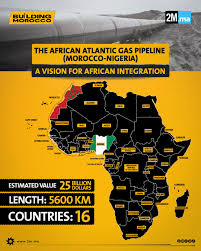
FREETOWN, Sierra Leone (XOL Africa) — West African leaders have signed an agreement providing a legal framework for the development of a multibillion-dollar natural gas pipeline linking Nigeria with Morocco, a project expected to strengthen regional energy security and open new export routes to Europe.
Heads of state of the Economic Community of West African States, known as ECOWAS, signed the Intergovernmental Agreement for the African Atlantic Gas Pipeline at the regional bloc’s summit in Freetown.
The agreement provides the sovereign framework needed to move the project from planning toward implementation, according to the Nigerian National Petroleum Company Limited, or NNPC.
The pipeline, jointly promoted by NNPC and Morocco’s Office National des Hydrocarbures et des Mines, ONHYM, is designed to transport about 30 billion cubic meters of natural gas annually from Nigeria through 13 West African coastal countries to Morocco, with potential onward connections to European markets through the Maghreb-Europe Gas Pipeline.
The proposed pipeline would stretch about 6,900 kilometers and is expected to support regional energy security, expand electricity generation, promote industrialization and create jobs while establishing an energy corridor linking West Africa, the Sahel, Morocco and Europe.
“This milestone reflects the clear mandate of His Excellency President Bola Ahmed Tinubu GCFR,” said Bashir Bayo Ojulari, group chief executive officer of NNPC Ltd.
“The AAGP is central to delivering that mandate by providing the infrastructure required to bring about 3 bcf/d of Nigerian gas to market. NNPC Limited is proud to co-lead this endeavour with ONHYM,” Ojulari said.
Amina Benkhadra, director general of ONHYM, described the signing as another major step in the development of the strategic pipeline.
“The Project fully reflects His Majesty’s vision for an integrated Atlantic Africa,” Benkhadra said.
The latest agreement implements approvals granted at the 66th Ordinary Session of the ECOWAS Authority of Heads of State and Government in Abuja in December 2024. It also completes a regional institutional process that followed a 2022 memorandum of understanding signed by Nigeria and Morocco.
Project promoters said significant preparatory work has already been completed, including front-end engineering design studies, route reconnaissance surveys, environmental and social impact assessments, as well as the development of legal, regulatory and commercial frameworks.
The pipeline is expected to supply up to 15 billion cubic meters of gas annually to Morocco and European markets while increasing gas utilization across West Africa.
The project is also expected to support industrial growth, value addition and sustainable employment in participating countries.
NNPC said Morocco and Mauritania will subsequently sign the agreement. The Pipeline Higher Authority will then be established in Abuja, while the AAGP Project Company will be based in Casablanca to oversee implementation and prepare the project for a final investment decision.
The project is expected to deepen regional economic integration while providing a new route for Nigeria to monetize its substantial natural gas resources and expand access to energy across West Africa.
SUPPORT AFRICAN BUSINESS JOURNALISM
Help XOL Africa expand independent business reporting across Africa.
SUPPORT XOL AFRICA →