



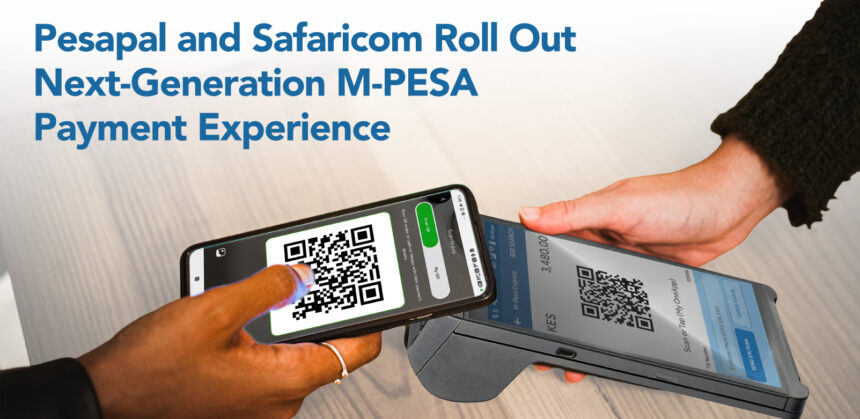
NAIROBI, (XOL Africa) — Safaricom and payments technology company Pesapal are rolling out new M-PESA payment options across Kenya, targeting faster checkout transactions as mobile money becomes increasingly embedded in the country’s retail economy.
The partnership brings QR code payments and contactless technology to Pesapal’s point-of-sale (POS) terminals, while Safaricom is introducing an artificial intelligence-powered feature designed to reduce the manual entry required for mobile payments.
The launch includes Dynamic Scan-to-Pay, Tap-to-Pay and AI Pay, extending M-PESA’s capabilities across physical retail transactions and payments initiated through the My OneApp application.
“As the way Kenyans shop and transact continues to evolve, we are focused on ensuring that M-PESA evolves with them,” said James Maitai, Safaricom’s group chief technology officer. He described the partnership as part of a broader effort to reshape everyday payment experiences.
Dynamic Scan-to-Pay allows customers to scan a QR code displayed on a Pesapal POS terminal. Merchant details and the amount payable are automatically populated, enabling customers to verify the information before completing the transaction.
Tap-to-Pay uses near-field communication (NFC) technology, allowing customers with compatible smartphones to tap their devices against a Pesapal terminal, check the transaction details and authorise payment.
For merchants, the technologies could reduce checkout friction and the risk of errors associated with manually entering payment information. Their commercial impact will depend on adoption by businesses and customers, as well as the availability of compatible devices.
Agosta Liko, Pesapal’s founder, described the integration as a significant advance for the country’s checkout infrastructure.
“Thousands of businesses trust our platform, and by teaming up with Safaricom, we are delivering the faster, error-free transactions their customers expect,” Liko said.
Safaricom is also introducing AI Pay through My OneApp, which has more than seven million downloads, according to the company. The feature allows users to scan printed or handwritten receipts and, where the information can be recognised, automatically populate the relevant M-PESA Till or PayBill details and payment amount.
The feature is intended to reduce the steps required to initiate payments, although Safaricom says the automatic identification of payment information depends on its availability on the receipt.
The rollout builds on an existing Scan-to-Pay network covering more than 60,000 merchant outlets. Safaricom aims to expand that footprint to 500,000 outlets within the next year, while Pesapal’s POS infrastructure provides an additional distribution channel for the new payment methods.
The expansion comes as payment providers seek to make digital transactions more convenient for consumers while giving merchants integrated tools to manage commerce. For Safaricom, the partnership extends M-PESA beyond its established mobile money functions and into the physical checkout experience.
Pesapal provides payment processing and business management tools to merchants across Kenya, Tanzania, Uganda, Rwanda and Zambia. Its platform also offers access to financing and other services intended to support businesses ranging from small merchants to larger enterprises.
Neither company disclosed the financial terms of the partnership or provided transaction-volume targets for the new services.
SUPPORT AFRICAN BUSINESS JOURNALISM
Help XOL Africa expand independent business reporting across Africa.
SUPPORT XOL AFRICA →