



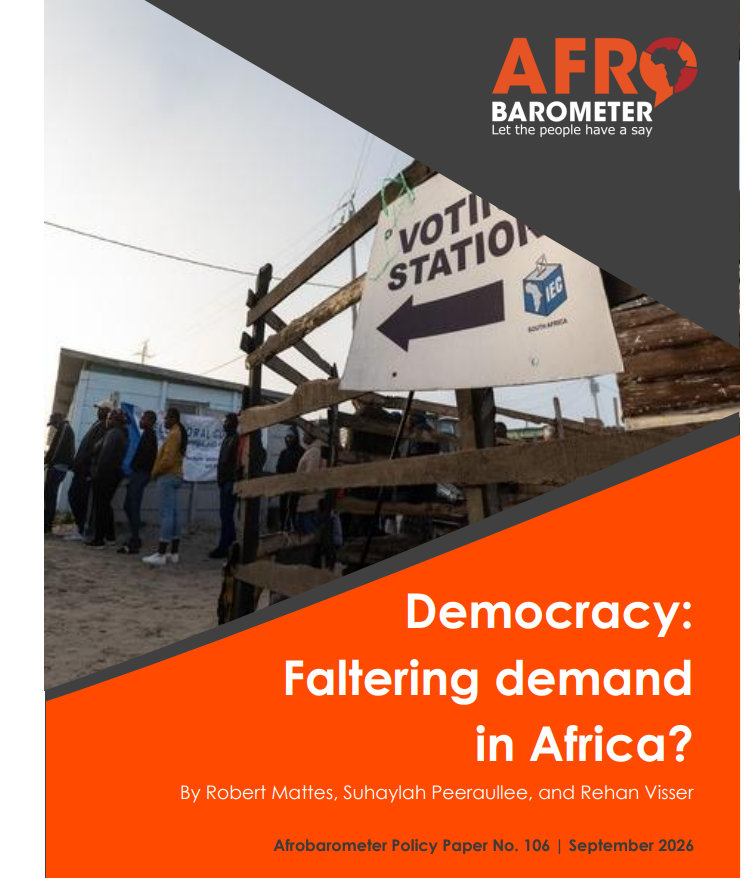
ABUJA, Nigeria — Demand for democracy has declined across much of Africa over the past decade, with Nigeria among the countries where citizens show mixed support for democratic government, according to a new Afrobarometer report.
The report, based on surveys conducted in 38 African countries in 2024 and 2025, found that 64% of respondents said democracy is preferable to any other form of government. But only 36% expressed what Afrobarometer calls a “full demand for democracy” — support for democracy combined with rejection of one-person, one-party and military rule.
Across 28 countries surveyed consistently over the past decade, full demand for democracy fell from 47% in 2014-2015 to 37% in 2024-2025, a decline of 10 percentage points, the report said.
Nigeria recorded 64% support for democracy as the preferred form of government in the latest survey. But the share expressing full demand for democracy was 39%, according to the report.
The findings also show that Nigerians overwhelmingly reject some authoritarian alternatives. Eighty-four percent said they opposed one-person rule, while 90% rejected one-party rule. Opposition to military rule was lower, at 66%.
Afrobarometer defines full demand for democracy as respondents who prefer democracy to any other form of government and reject presidential dictatorship, one-party rule and military rule.
The report said the decline in democratic commitment was not confined to countries with recent military takeovers. Demand also fell substantially in several countries that had previously been classified as having strong electoral competition and political freedoms.
Among those countries, Mauritius recorded a 26-percentage-point decline in full demand for democracy over the decade, followed by South Africa with a 21-point decline and Namibia with a 20-point decline. Cabo Verde and São Tomé and Príncipe each recorded a 16-point decline.
The report also identified declines in several countries classified as electoral democracies, including Mali, Côte d’Ivoire, Malawi, Botswana and Lesotho. At the same time, demand increased in countries including Liberia, Kenya, Uganda, Tanzania, Mozambique, Madagascar, Morocco and Zambia.
Afrobarometer said the narrowing gap between what Africans want from democracy and what they believe they receive should not necessarily be interpreted as evidence that democratic governance has substantially improved.
“the gap is tightening because Africans are increasingly open to authoritarian forms of government,” the report said.
The survey found that fewer than half of Africans, 47%, described their country as a democracy with minor problems or a full democracy. Only 38% said they were fairly or very satisfied with the way democracy works in their country.
Nigeria was among the countries with relatively low assessments of democratic governance. Just 27% of Nigerian respondents described their country as a democracy with minor problems or a full democracy, while 16% said they were satisfied with the way democracy works.
The report attributed the broader decline in democratic commitment partly to worsening assessments of government performance. Across 30 countries surveyed in both 2014-2015 and 2024-2025, respondents were more likely to say presidents ignore the law and Parliament, elections have major problems, criminals go unpunished and lawmakers are corrupt. Respondents also reported declining freedom to express their views and join organizations.
Afrobarometer said these trends suggest that dissatisfaction with government performance is closely associated with declining commitment to democracy.
The organization said the findings highlight the importance of electoral integrity, political freedoms, government accountability and economic security in maintaining public commitment to democratic government.
The survey’s findings are based on 50,961 face-to-face interviews across 38 countries, with country-level margins of error generally between plus or minus 2 and 3 percentage points at a 95% confidence level.
SUPPORT AFRICAN BUSINESS JOURNALISM
Help XOL Africa expand independent business reporting across Africa.
SUPPORT XOL AFRICA →