



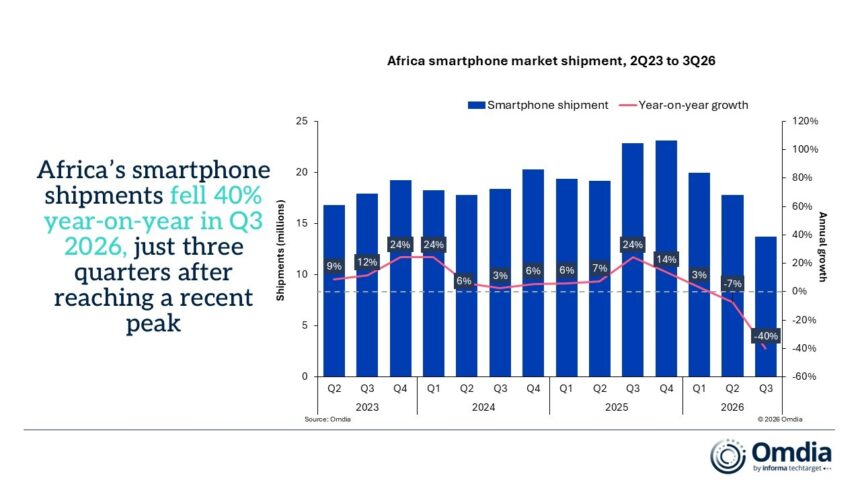
Africa’s smartphone market suffered its steepest annual contraction in three years in the third quarter of 2026, as rising component costs, currency depreciation and weakening consumer purchasing power pushed millions of buyers away from new devices.
Smartphone shipments fell 40% year-on-year to 13.7 million units in the three months to September, down from 22.8 million in the same period last year, according to research firm Omdia. The decline followed three consecutive years of third-quarter growth and underscores mounting pressure on manufacturers operating in the continent’s price-sensitive markets.
The downturn has been particularly severe in the entry-level segment, traditionally the main driver of smartphone adoption across much of Africa. Shipments of devices priced below $100 plunged nearly 70%, while feature phone shipments increased 27%, suggesting that consumers are increasingly prioritising affordability over access to more advanced mobile technology.
“The figures show how affordability is shaping buying decisions in Africa,” said Manish Pravinkumar, principal analyst at Omdia. He added that some consumers were postponing upgrades or turning to refurbished smartphones to remain within their budgets.
The affordability squeeze has also undermined the market’s overall value. Although the average selling price of smartphones in Africa reached $222 in the third quarter, its highest third-quarter level in a decade, market value still declined 15%.
The higher average price does not necessarily indicate an improvement in consumer demand for premium devices. Rather, it reflects rising production and import costs, which are making smartphones increasingly expensive for households.
Nigeria, Egypt bear the brunt of the contraction
Nigeria recorded the steepest decline among Africa’s major smartphone markets, with shipments falling 47% year-on-year.
The country’s market has been affected by higher fuel costs following the removal of petrol subsidies, limited access to foreign currency for import payments and rising handset prices. These pressures have further constrained household purchasing power in a market where cash purchases remain significant.
Egypt recorded a 41% decline as the depreciation of the Egyptian pound and persistent inflation increased the cost of importing smartphones and manufacturing them locally.
In Kenya, shipments fell 35%, while deliveries in the country’s core segment of smartphones priced below $150 dropped 44%. The figures highlight the growing difficulty of sustaining demand among lower-income consumers as device prices rise. Credit purchases and instalment payment schemes are becoming increasingly important in helping buyers manage upfront costs.
South Africa proved relatively more resilient, recording a 20% decline. Established mobile operator distribution networks, contract upgrades and a wider range of retail channels helped cushion the downturn. However, high smartphone penetration, pressure on household finances and longer replacement cycles continued to weigh on demand.
TRANSSION retains market leadership as Samsung gains ground
The contraction has reshaped competition among smartphone manufacturers, with Samsung gaining market share despite a decline in shipments.
TRANSSION, whose portfolio includes TECNO, Infinix and itel, retained its position as Africa’s largest smartphone vendor, accounting for 48% of shipments in the third quarter. However, its deliveries fell 43% to 6.6 million units, reflecting its exposure to the shrinking market for devices priced below $100.
Samsung recorded the smallest shipment decline among the five leading manufacturers, with deliveries down 8% to 3.1 million units. Its market share increased from 15% to 23%, supported by relationships with mobile operators and its broad Galaxy A-series portfolio.
The Galaxy A07 4G and A17 4G accounted for 56% of Samsung’s smartphone shipments in Africa during the quarter, highlighting the importance of affordable models in maintaining market presence.
Xiaomi experienced a sharper setback, with shipments declining 49% to 1.5 million units. Price increases across its portfolio weakened demand from distribution partners and reduced its share of consumer spending.
HONOR shipments fell 14% to 800,000 units, following nearly three years of triple-digit growth. Its earlier expansion in South Africa and other African markets had supported its rise, but higher handset prices are now testing the sustainability of that growth.
OPPO recorded the steepest decline among the leading vendors, with shipments plunging 69% to 500,000 units as it reorganised its operations following its integration with realme.
Financing and tax reforms offer a route to recovery
Omdia expects Africa’s smartphone shipments to decline 23% for the full year in 2026, followed by a further 25% contraction in 2027.
The outlook presents a significant challenge for manufacturers seeking to balance rising production costs with the need to maintain competitive prices in markets where affordability remains the principal driver of demand.
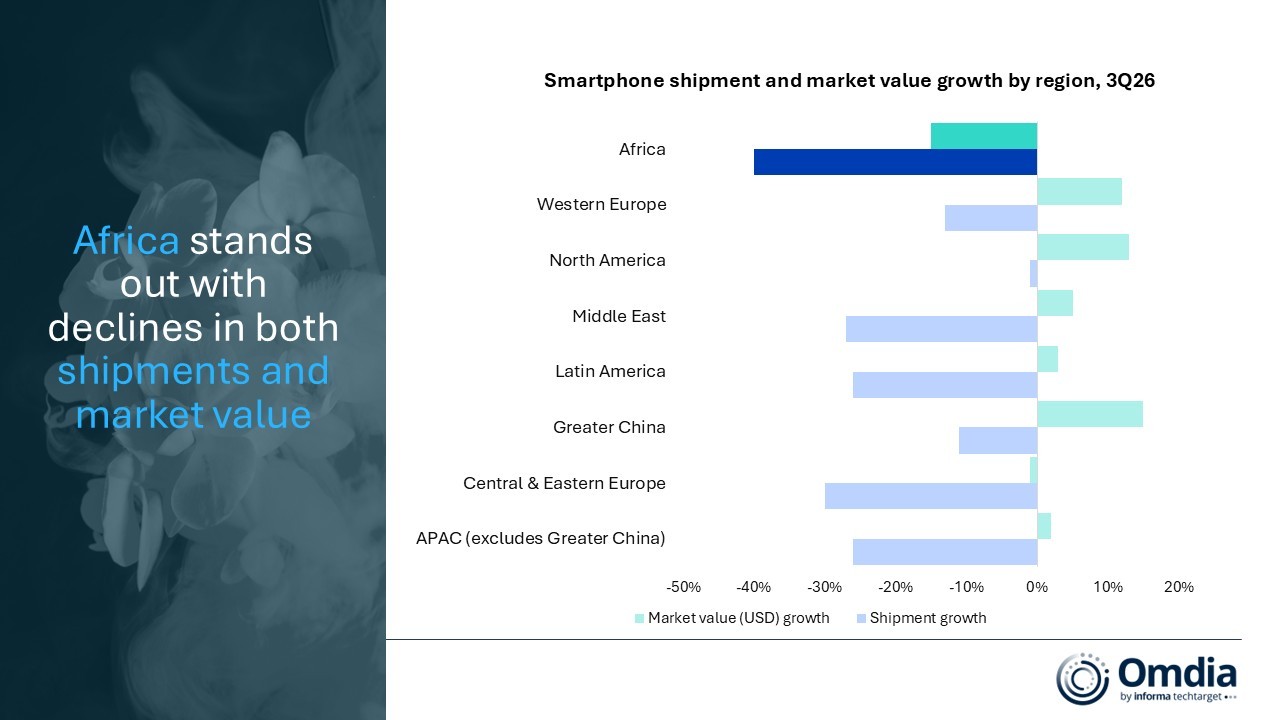
Tax reforms and consumer financing could provide some relief. Morocco, for example, has reduced its import duty on smartphones from 17.5% to 2.5%, a move that could ease the cost burden on suppliers and consumers.
Mobile operators and financial services providers are also expanding alternative purchasing arrangements. Vodacom has introduced prepaid handset financing across its African markets, while vivo is working with Nigeria’s Credit Direct to offer device financing. M-KOPA, meanwhile, continues to expand its smartphone financing model.
Such initiatives could help broaden access to smartphones, particularly among consumers unable to pay the full purchase price upfront.
However, Omdia argues that a sustainable recovery will require closer cooperation between governments, manufacturers and mobile operators to support local production, reduce distribution costs and expand access to affordable credit.
For Africa’s mobile industry, the challenge is no longer simply expanding smartphone penetration. It is finding commercially viable ways to keep connected devices within reach of a population facing mounting economic pressures.
The next phase of growth will depend on whether manufacturers and policymakers can close the widening gap between the cost of smartphones and what consumers can afford.
SUPPORT AFRICAN BUSINESS JOURNALISM
Help XOL Africa expand independent business reporting across Africa.
SUPPORT XOL AFRICA →