


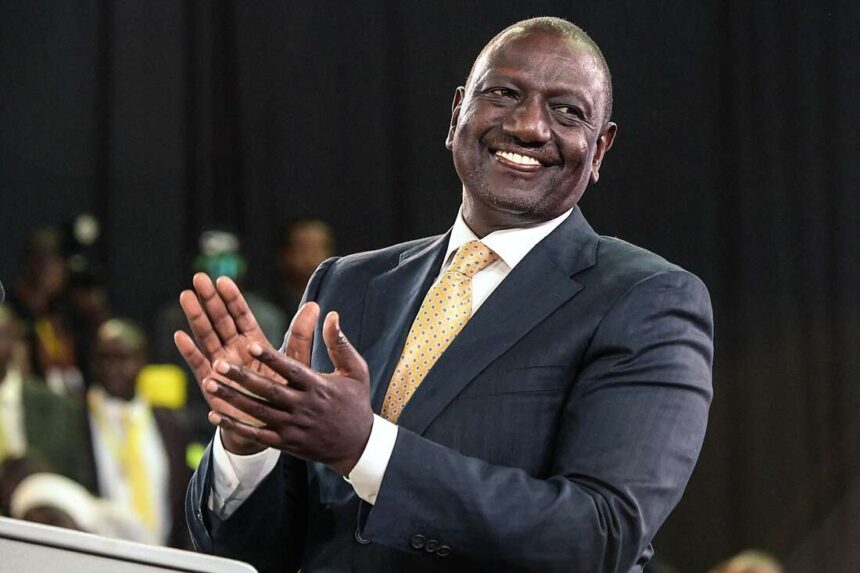
NAIROBI, Kenya (XOL Africa)— President William Ruto has ordered Kenyan authorities to begin shutting down small businesses operated by foreign nationals from September 7, arguing that hawking and other low-capital retail activities should be reserved for Kenyan citizens.
Ruto told micro, small and medium-sized traders at State House in Nairobi on Wednesday that Kenya remained open to foreign investment, but said foreigners should not compete with citizens in businesses requiring limited capital.
“From next week, all traders doing those small businesses should close them,” Ruto said.
“We have made efforts to improve the economy. We have not improved investor confidence for hawkers to come to Kenya,” he added.
The president said his government would introduce legal restrictions defining economic activities that should be prioritised for Kenyan citizens. He directed National Assembly Majority Leader Kimani Ichung’wah and Trade Cabinet Secretary Lee Kinyanjui to accelerate legislation before parliament.
The proposed Local Content Bill, 2025, would require foreign companies to employ Kenyans as at least 80 per cent of their workforce and source at least 60 per cent of specified goods and services locally. Manufacturers using agricultural produce would be required to source it entirely from Kenyan farmers.
“It cannot be that a person comes from China or elsewhere to be a hawker or open a small shop,” Ruto said.
The measures come as governments and businesses across Africa grapple with rising political pressure over immigration and competition for jobs and customers. The issue has been particularly contentious in South Africa, where anti-immigration groups have targeted migrants and foreign-owned businesses in campaigns calling for restrictions on their commercial activities and access to public services.
Kenya has not experienced anti-migrant violence on the scale seen in South Africa. But Ruto’s comments have raised concerns that economic grievances could increasingly be framed in terms of nationality, particularly as foreign traders become more visible in informal markets and small-scale retail.
Those tensions surfaced recently in Nairobi when a Burundian street vendor was confronted and accused of taking commercial opportunities from Kenyans.
Ruto’s intervention also comes as his administration seeks to address persistent pressure over employment and the cost of living. Small and informal businesses account for a large share of employment in Kenya, making competition in low-capital retail a politically sensitive issue.
The government’s proposed restrictions could give Kenyan traders greater access to parts of the informal economy, but they also risk complicating the country’s longstanding effort to attract foreign capital and position itself as a regional commercial hub.
The distinction between foreign investment and small-scale foreign-owned businesses is likely to become central to implementation. While Ruto has stressed that Kenya remains open to international investors, the proposed rules would give the government greater scope to determine which commercial activities are considered sufficiently capital-intensive or strategically important to remain open to foreigners.
SUPPORT AFRICAN BUSINESS JOURNALISM
Help XOL Africa expand independent business reporting across Africa.
SUPPORT XOL AFRICA →