


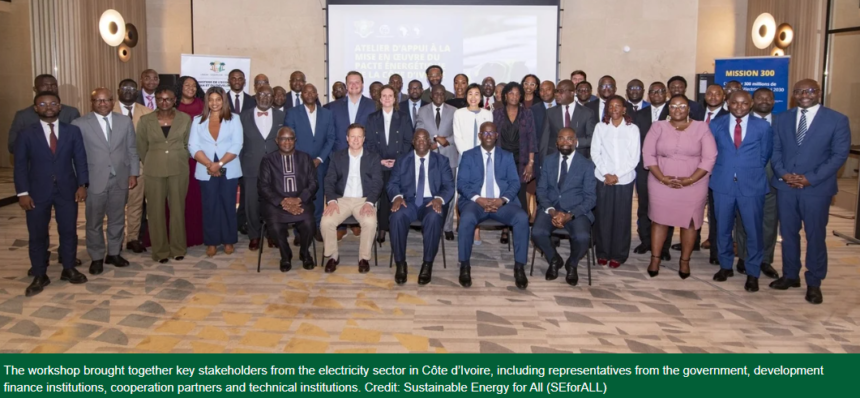
ABIDJAN, Côte d’Ivoire — Côte d’Ivoire is stepping up efforts to implement its national energy plan, with government officials, development finance institutions and technical partners meeting in Abidjan to advance reforms, develop priority projects and mobilize financing ahead of the country’s 2030 energy targets.
The two-day workshop, held Sept. 9-10, focused on implementing Côte d’Ivoire’s National Energy Compact under Mission 300, a joint initiative of the African Development Bank Group and World Bank Group aimed at connecting an additional 300 million people to electricity across Africa by 2030.
“We are determined to play our full part in driving sectoral reforms, bringing projects to maturity and coordinating with implementing bodies,” said Souleymane Soro, deputy chief of staff to the Ivorian minister for mines, oil and energy. “We will ensure that the identified priorities are translated into coherent, monitored and measurable actions.”
Côte d’Ivoire unveiled its National Energy Compact in January 2025. The plan sets four targets for 2030: universal access to electricity, a 50% clean-cooking access rate, a 45% share of renewable energy in the country’s energy mix and the mobilization of an additional $2 billion in private investment.
The country has made progress toward those targets. In 2025, 684,735 new electricity connections provided access to electricity for about 3.56 million additional people, according to the African Development Bank. Clean-cooking access reached about 41%, while renewable energy accounted for 34% of the energy mix.
By early 2026, five of the Compact’s 23 actions had been completed, 12 were under way and six were behind schedule.
Priority areas include regulation of mini-grids and self-generation, electricity tariff reforms, the financial sustainability of the power sector, bioenergy, clean cooking and regional electricity integration.
The Compact estimates that $15.02 billion in investment will be needed through 2030, with about $6.56 billion still to be mobilized.
“Côte d’Ivoire is starting from a strong position,” said Wale Shonibare, director of financial solutions, energy policy and regulation at the African Development Bank. “The country has one of the most developed electricity systems in West Africa, has long relied on a model of private-sector participation in electricity generation, and plays an important role in regional electricity trade.”
Shonibare said the focus now is on accelerating implementation.
“The challenge, therefore, is not merely to set ambitious targets, but to accelerate their implementation at the scale and pace required to meet the 2030 targets,” he said.
He said closer coordination between the Ivorian government, the African Development Bank, the World Bank and other development partners would be needed to mobilize financing and move priority projects forward.
Participants used the Compact Implementation Support Document as a roadmap for identifying actions involving regulatory reforms, project development, financing, monitoring and risk management.
The discussions covered the preparation and financing of projects involving solar power, hydropower, biomass, electricity transmission and distribution, regional interconnections, energy storage and expanded electricity access.
Marcelin Cissé, director-general of the Planning Ministry, representing the minister for planning and development, said Côte d’Ivoire had established institutional oversight mechanisms to guide implementation of the roadmap.
The African Development Bank Group is supporting the country through investment financing, technical assistance, project preparation and coordination with development partners.
Its support includes the Programme for the Strengthening of Transport and Distribution Networks, known as PRETD, as well as the second phase of the Project to Strengthen Electricity System Infrastructure and Improve Access to Electricity, or PROSER II, implemented in partnership with the Islamic Development Bank.
Mission 300 is jointly led by the African Development Bank Group and World Bank Group. The initiative seeks to connect 300 million additional people across Africa to electricity by 2030.
Sustainable Energy for All facilitated the Abidjan workshop with support from the African Development Bank Group’s African Energy Sector Technical Assistance Programme.
SUPPORT AFRICAN BUSINESS JOURNALISM
Help XOL Africa expand independent business reporting across Africa.
SUPPORT XOL AFRICA →