



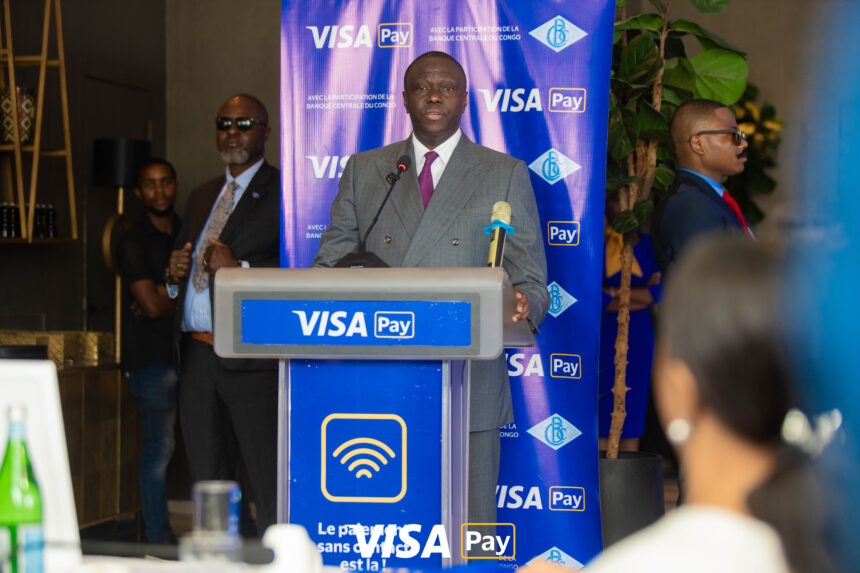
Visa has launched a smartphone-based contactless payment service in the Democratic Republic of Congo, allowing consumers to make purchases using Android devices as the central African country seeks to expand financial inclusion and reduce its reliance on cash.
The US payments group said on Wednesday that eligible users of its Visa Pay platform could now make transactions by tapping near-field communication (NFC)-enabled Android smartphones at terminals accepting Visa contactless payments.
The service is being introduced through participating financial institutions, including Access Bank, Sofibanque, Solidaire Banque and United Bank for Africa (UBA).
The DRC is the first market where the Tap to Pay functionality has been introduced through the Visa Pay application, marking a further expansion of the company’s digital payments operations in Africa.
The launch follows a demonstration on November 16, when the governor of the Central Bank of Congo completed the first transaction using the technology at an event attended by representatives of Visa, commercial banks and other participants in the payments industry.
The initiative forms part of the central bank’s efforts to accelerate digital transactions and advance the country’s cashless economy agenda by 2027.
DRC seeks to close financial inclusion gap
The expansion comes as the DRC seeks to increase access to formal financial services in a country where conventional banking infrastructure remains limited in many areas and mobile technology offers an alternative channel for payments.
Visa Pay, introduced in the DRC a year ago, is designed to connect consumers across participating banks and mobile networks, allowing users to send and receive money and make digital payments.
The platform serves both banked and previously unbanked consumers through participating financial institutions, while virtual cards enable online purchases.
The addition of contactless smartphone payments extends those capabilities into physical retail transactions, allowing eligible users to pay merchants without carrying cash or a physical bank card.
Speaking at the launch event, the central bank governor said digitalisation was essential to widening financial inclusion.
“In my vision, our country can only close its financial inclusion gap through digitalization,” the governor said.
“We needed a global brand to lead by example. With Visa Pay, the global financial ecosystem sees the Democratic Republic of Congo as a land of opportunity for developing digital solutions.”
He added that the introduction of contactless payments just one year after Visa Pay’s launch demonstrated progress in the country’s digital financial infrastructure.
The central bank has identified greater adoption of electronic payments as part of its broader ambition to modernise the financial system and increase participation in the formal economy.
Banks and merchants gain new payment options
The new service uses Visa’s tokenisation technology, which replaces sensitive payment credentials with digital tokens, alongside device authentication to help protect transactions.
For consumers, the system is intended to simplify everyday purchases by allowing payments directly from compatible smartphones.
For participating banks, the technology provides an additional channel through which to offer mobile payment services and encourage customers to use digital financial products.
Merchants with existing Visa contactless payment terminals can accept transactions from eligible Visa Pay users without requiring a separate smartphone payment system.
Sophie Kafuti, Visa’s cluster head for the DRC, said the launch reflected the company’s commitment to supporting the central bank’s digital payments strategy.
“The addition of Tap to Pay on Visa Pay represents an important milestone in making digital payments more accessible, secure and convenient across the DRC,” Kafuti said.
“By extending Visa Pay into physical commerce, we are helping Congolese consumers pay with confidence in the DRC and abroad while creating new opportunities for banks, merchants and the wider payments ecosystem.”
The service’s reach will nevertheless depend on the availability of NFC-enabled Android devices, participating financial institutions and merchants equipped with compatible payment terminals.
Africa’s digital payments market expands
The DRC launch reflects a wider shift in African financial services as banks, telecommunications operators and international payments companies seek to expand digital transactions and connect consumers who have traditionally relied on cash.
Mobile money platforms have already become an important part of financial services across several African markets, particularly where access to conventional banking remains constrained.
Visa’s approach in the DRC seeks to build on existing banking and mobile payment infrastructure while extending digital transactions into retail commerce.
The interoperability of Visa Pay across participating banks and mobile networks is intended to reduce fragmentation between financial service providers and make it easier for consumers to move money.
For the DRC, expanding digital payments could also help bring more transactions into the formal financial system, although widespread adoption will depend on affordability, connectivity, merchant acceptance and consumer trust.
Visa said the introduction of Tap to Pay demonstrated how its international payment technologies could be adapted to local market requirements.
The company did not disclose the number of Visa Pay users in the DRC, the volume of transactions processed since the platform’s introduction or financial projections for the new contactless service.
It also did not announce plans or a timetable for introducing the sam
SUPPORT AFRICAN BUSINESS JOURNALISM
Help XOL Africa expand independent business reporting across Africa.
SUPPORT XOL AFRICA →