


The United States and Madagascar have signed a military logistics agreement aimed at strengthening maritime security in the western Indian Ocean, expanding Washington’s defence co-operation with African partners along strategically important shipping routes.
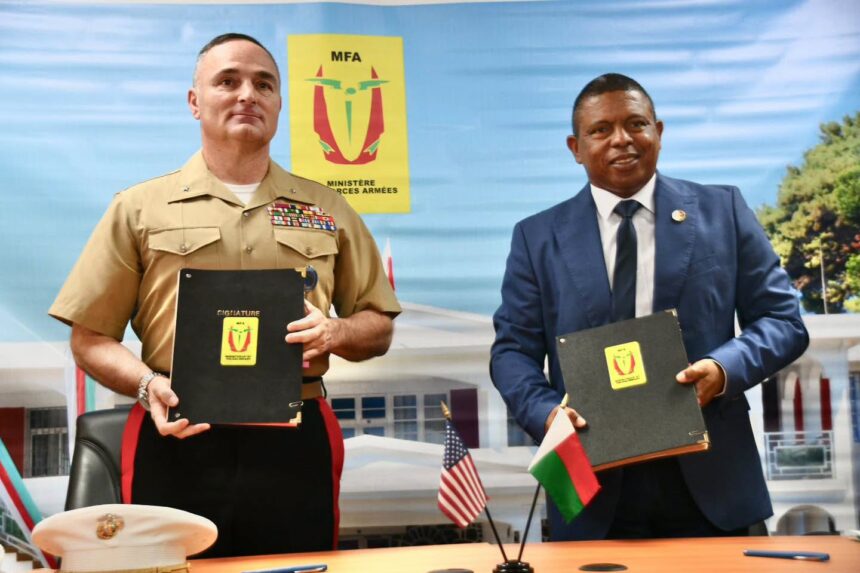
The Acquisition and Cross-Servicing Agreement (ACSA), signed in Antananarivo by US Africa Command (AFRICOM) deputy director for operations General Thomas M. Armas and Madagascar’s armed forces minister General Maminirina Ely Razafitombo, establishes a framework for the two militaries to exchange logistical supplies, equipment and services.
The agreement is intended to improve operational readiness during joint maritime patrols, military exercises and humanitarian emergencies, particularly in the Mozambique Channel, a significant maritime corridor separating Madagascar from mainland Africa.
The signing comes as Washington seeks to deepen security partnerships across Africa’s Indian Ocean coastline, where maritime trade, illegal fishing, transnational crime and natural disasters have increased the importance of regional co-operation.
Under the agreement, US and Malagasy forces will be able to provide reciprocal logistical support, including fuel, spare parts, storage facilities and other essential services, without negotiating separate arrangements for each operation.
“Operations cannot succeed without reliable logistics,” Armas said at the signing ceremony.
“Whether responding to an unexpected cyclone or securing vital waters across the Mozambique Channel, this agreement guarantees that our forces can support one another rapidly.”
Armas said the arrangement would respect Madagascar’s sovereignty and operate within the laws of both countries, while improving the ability of Malagasy military personnel to respond to security threats and emergencies.
The agreement also provides mechanisms for reciprocal pricing and exchanges in kind, allowing Madagascar to use domestic military infrastructure, including ports, secure storage facilities and training areas, in return for logistical support and equipment.
Such arrangements could help the country stretch its limited defence resources while improving the maintenance and operational readiness of its armed forces.
The Mozambique Channel is an important route for commercial shipping and energy transportation, connecting the Indian Ocean with markets in Africa, Asia and beyond.
For Madagascar, whose extensive coastline presents significant maritime surveillance challenges, closer logistical co-operation with the US could strengthen its ability to monitor territorial waters and participate in multinational security operations.
The agreement will support participation in exercises such as Cutlass Express, a US-led maritime security initiative involving African and international partners that focuses on improving naval co-operation, information sharing and responses to maritime threats.
Following the signing, military officials from both countries held a logistics roundtable under the Assess, Advise, Advocate, Integrate (A3I) framework.
The initiative will allow Malagasy military planners to identify priority infrastructure and logistical requirements at strategic ports and bases, including Antsiranana, Toamasina and Mahajanga.
The assessments are expected to help Madagascar prepare proposals for international grant funding, equipment maintenance and other forms of logistical assistance.
Separately, 24 Malagasy military personnel from the army, navy and air force participated in a one-and-a-half-day training programme covering the administrative and operational procedures required to implement the agreement.
The training focused on managing logistics orders, emergency refuelling, aviation support and the exchange of services between the two militaries.
The signing follows a visit to Madagascar two weeks earlier by AFRICOM deputy commander Lieutenant General John Brennan, reflecting an intensification of bilateral defence engagement.
Madagascar now joins more than 30 African partner countries that have concluded similar logistics agreements with the US military, according to AFRICOM.
The expansion of such arrangements reflects Washington’s preference for building military partnerships through logistical support, training and interoperability rather than relying exclusively on permanent overseas bases.
For African governments, these agreements can offer access to military support and technical expertise while preserving national control over defence infrastructure and operations.
The latest pact also highlights the growing strategic importance of the western Indian Ocean, where maritime security, disaster preparedness and access to critical transport corridors have become central to regional stability.
US Chargé d’Affaires Tom Bevan and embassy defence attaché Commander Michelle Calarasu attended the signing alongside senior Malagasy military officials.
Neither government disclosed the financial value of the agreement or a timetable for specific joint operations.
The arrangement establishes a framework for future logistical exchanges rather than a commitment to particular military deployments, with implementation subject to the applicable laws and operational requirements of both countries.
SUPPORT AFRICAN BUSINESS JOURNALISM
Help XOL Africa expand independent business reporting across Africa.
SUPPORT XOL AFRICA →