


Germany has pledged €500,000 to the World Trade Organization’s Global Trust Fund, providing fresh support for trade capacity-building programmes that could help African economies strengthen export competitiveness and navigate increasingly complex international trade rules.
The contribution, equivalent to approximately CHF 460,000, comes as African countries seek to expand their participation in global value chains while implementing the African Continental Free Trade Area (AfCFTA), which aims to deepen regional economic integration.
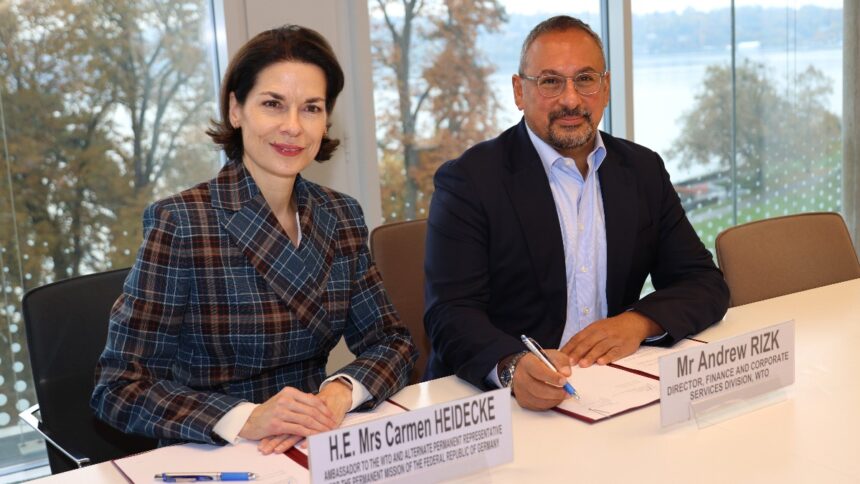
Germany’s ambassador to the WTO, Carmen Heidecke, formalised the pledge in Geneva on November 9, bringing Berlin’s cumulative contributions to the fund to more than CHF 28mn since its establishment in 2000.
The funding will support technical assistance for developing and least-developed economies, including programmes covering agricultural exports, digital trade, import licensing, product standards and trade negotiations.
For African exporters, compliance with international standards and complex customs requirements remains an obstacle to accessing higher-value markets. Strengthening institutional expertise could help governments improve trade administration and businesses navigate regulatory requirements.
WTO director-general Ngozi Okonjo-Iweala welcomed the contribution, warning that financial support for trade-related technical assistance was weakening.
“Germany’s generous contribution to the Global Trust Fund comes at a critical time for developing economies and least developed countries,” she said.
“This funding will help maintain and enhance valuable technical assistance activities, at a time when many are pulling back on such support.”
The Global Trust Fund finances approximately 280 activities annually, providing training to government officials and other participants involved in trade policy and implementation.
Its programmes are particularly relevant to African economies seeking to move beyond raw commodity exports into higher-value manufacturing, agricultural processing and digital services.
They could also complement efforts under the AfCFTA to reduce trade barriers and improve regulatory coordination, although Germany’s latest contribution has not been specifically earmarked for Africa.
Heidecke said Berlin remained committed to strengthening developing countries’ participation in the multilateral trading system.
“We believe that providing reliable funding to this essential WTO technical assistance and capacity-building fund helps ensure that developing and least developed members are empowered to equally participate in the multilateral rules-based trading system,” she said.
Andrew Rizk, the WTO’s director of finance and corporate services, said the contribution would help developing economies implement trade rules, participate more actively in WTO negotiations and respond to emerging commercial challenges.
Since its establishment, the fund has supported more than 2,800 training workshops worldwide, with approximately 19,000 participants receiving training in 2024.
For African governments, the challenge extends beyond securing access to international markets. Building the technical and regulatory capacity to use that access effectively will be critical to translating trade agreements into export growth, investment and employment.
SUPPORT AFRICAN BUSINESS JOURNALISM
Help XOL Africa expand independent business reporting across Africa.
SUPPORT XOL AFRICA →