


Russian President Vladimir Putin has called on African governments to connect to a Russian-backed international payments platform, positioning the technology as a means of strengthening financial sovereignty and reducing reliance on Western banking infrastructure.
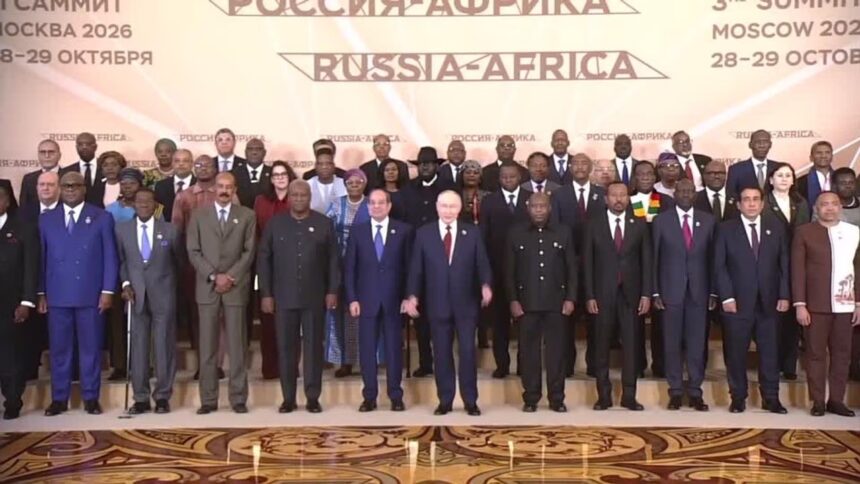
Speaking during a presentation of Russian technologies at what was described as the third Russia–Africa Summit, Putin promoted A7, an international settlement platform designed to facilitate cross-border payments using conventional and digital currencies.
The Russian president said advances in financial technology could allow African countries to conduct international transactions more efficiently while reducing their exposure to restrictions imposed through existing global payment networks.
“Digital currencies are developing in both the US and Russia. Why shouldn’t the African continent connect to this high-tech system?” Putin said.
The proposal reflects Moscow’s broader effort to develop alternative financial infrastructure following Western sanctions that have restricted Russian banks’ access to international payment systems since the invasion of Ukraine in 2022.
Moscow targets Africa’s cross-border payments market
Putin presented the platform as a sovereign alternative to established international settlement arrangements, arguing that its technological architecture could protect participating countries from external interference.
“No one will be able to block your transactions. From a technological standpoint, it is simply impossible to cut off these types of settlements. Absolutely impossible,” he said.
The claim could appeal to African governments seeking greater control over international financial transactions, particularly as the continent works to reduce payment costs, improve trade settlement and strengthen financial integration.
However, the ability of any payment platform to operate independently of international restrictions depends on several factors, including banking relationships, regulatory approvals, currency convertibility and compliance with applicable sanctions.
Russia’s proposed infrastructure would also face competition from established international payment networks and African-led initiatives, including the Pan-African Payment and Settlement System (PAPSS), which is intended to facilitate cross-border transactions in African currencies.
A7 promises instant settlements at 0.3% cost
According to the account of the presentation, Russian finance minister Anton Siluanov said A7 could process international transactions almost instantaneously, with fees significantly below those associated with some conventional cross-border payment arrangements.
“Payments are executed instantly in a single click, and the transaction cost is just 0.3%, which is remarkably low,” Siluanov said.
The stated fee could make the platform attractive to businesses engaged in international trade, although the overall cost to users would also depend on foreign exchange conversion charges, liquidity and the availability of participating financial institutions.
Maxim Oreshkin, deputy chief of staff of Russia’s presidential administration, said Russian banks were already working with foreign financial institutions and non-bank payment providers to facilitate international transactions outside Western-dominated networks.
He said Moscow was prepared to extend these technologies to partner countries, presenting the initiative as part of a wider effort to establish alternative channels for global trade and investment.
Nigeria and Zimbabwe emerge as expansion hubs
A7 has identified Africa as an important market for its international expansion, establishing representative offices in Nigeria and Zimbabwe in 2025, according to information provided about the company.
The two countries could serve as entry points into different African markets, although the establishment of representative offices does not necessarily indicate regulatory approval to provide payment services or widespread adoption by local banks.
Nigeria, Africa’s most populous country, has a substantial financial technology industry and significant demand for international payment services. Zimbabwe, meanwhile, has experienced prolonged currency instability, making access to reliable settlement infrastructure an important consideration for businesses.
Founded in 2024 with the participation of Russian lender Promsvyazbank, also known as PSB, A7 says
SUPPORT AFRICAN BUSINESS JOURNALISM
Help XOL Africa expand independent business reporting across Africa.
SUPPORT XOL AFRICA →