



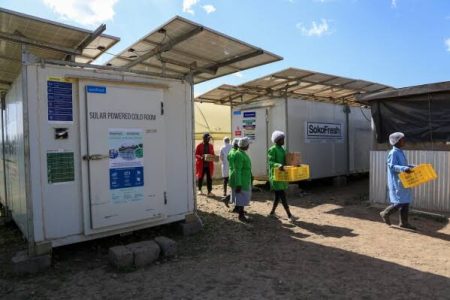
LAGOS, Nigeria — A United Kingdom-backed clean energy fund will support the installation of 100 solar-powered cold storage systems and four agricultural hubs in Nigeria as part of an investment exceeding £2 million across eight African countries.
The projects, supported by the ZE-Gen Scale-up Fund, aim to help farmers, food vendors and agricultural processors reduce reliance on petrol and diesel generators, lower operating costs and limit post-harvest food losses.
Farm Warehouse will install 100 solar-powered cold storage systems in major Nigerian markets, targeting traders selling perishable products such as fish, meat and dairy.
The systems will combine solar power, refrigeration and digital marketplace services to help vendors preserve products for longer and connect with potential buyers.
KAMIM Technologies will establish four solar-powered agricultural hubs integrating irrigation, cold storage, ice production and grain processing. The facilities are designed to address infrastructure gaps that force farmers to sell produce quickly, restrict processing opportunities and increase the risk of post-harvest losses.
The Nigerian projects are among 10 initiatives selected to expand the commercial deployment of clean energy technologies and business models beyond pilot stages.
The fund is backed by the UK government’s Ayrton Fund through the Transforming Energy Access platform.
Across the other participating African countries, the programme will support projects serving healthcare facilities, telecommunications networks, fishing communities, rural households and small businesses.
In Kenya, Acele Africa will deploy locally designed modular battery systems, while SHIELD, a spin-out from the University of Oxford, will begin a project to help a major hospital transition from diesel generators to solar power and battery storage.
In Uganda, battery company AceOn will install energy storage systems for telecommunications and healthcare facilities while testing sodium-ion batteries as an alternative to lithium-ion technology.
Other initiatives will support solar-powered fishing hubs in Mozambique, second-life battery storage in Rwanda, modular batteries for mini-grids in Lesotho, rural electrification in Madagascar and solar energy systems for small businesses in Tanzania.
ZE-Gen Programme Director Lily Beadle said the projects “show how clean energy can power the services and businesses people rely on every day”.
“The next challenge is scaling the most successful approaches,” she added.
For Nigeria’s agricultural sector, the planned installations are intended to bring reliable refrigeration and processing infrastructure closer to markets and farming communities, helping traders preserve perishable goods and enabling producers to retain more value from their harvests.
SUPPORT AFRICAN BUSINESS JOURNALISM
Help XOL Africa expand independent business reporting across Africa.
SUPPORT XOL AFRICA →