


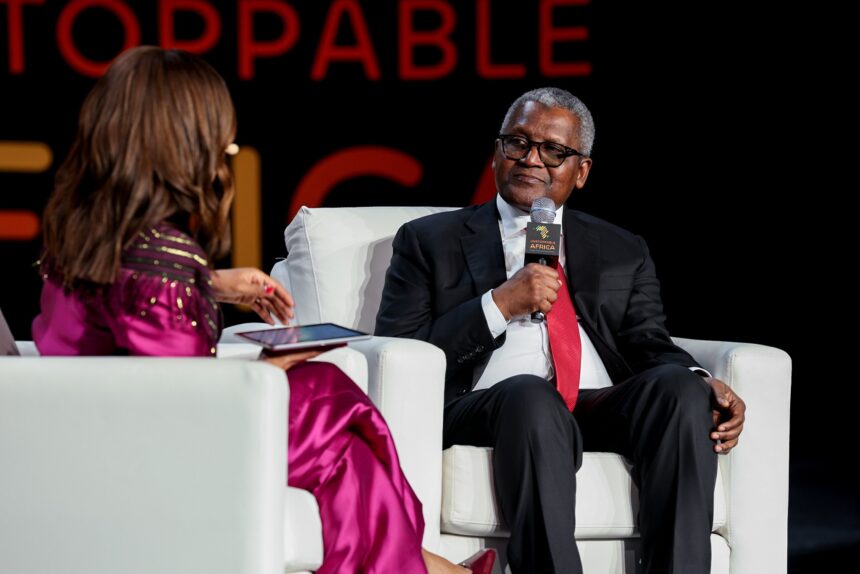
NEW YORK, Sept. 22, 2026 (XOL Africa) — African businesses should invest more of the continent’s capital at home to build industrial capacity and capture a larger share of its economic growth, billionaire industrialist Aliko Dangote told global business leaders at the Unstoppable Africa 2026 forum in New York.
Dangote, president and chief executive of Dangote Group, argued that Africa cannot achieve the scale of industrialisation seen in Asia while significant amounts of African capital continue to be held or invested abroad.
“We must believe in our continent,” Dangote said, urging African businesses to pursue large-scale investments despite the difficulties of operating and building major companies on the continent.
“Once you start, it gets easier. But the more you don’t do anything, it becomes difficult,” he said.
More than 3,000 African and international business leaders and heads of state attended the two-day forum, where industrialisation, investment, trade and technology were among the central themes.
Dangote also pointed to the African Continental Free Trade Area as a key mechanism for creating the market scale needed to support major industrial projects and strengthen intra-African trade.
The discussions reflected growing efforts to attract investment into African industries while increasing local value creation rather than exporting raw materials for processing elsewhere.
Calls for deeper financial markets
Eine Zeidane, director of the African Department at the International Monetary Fund, highlighted the importance of structural reforms, stronger domestic financial markets and wider regional markets through AfCFTA in attracting private investment.
South Africa’s business and investment proposition also featured prominently through the South African Business Initiative for Impact, which focused on connecting domestic opportunities with international capital and partnerships.
The forum also examined Africa’s rapidly expanding digital economy.
Olugbenga Agboola, chief executive of Nigerian payments company Flutterwave, highlighted the continent’s young and increasingly connected population and the potential of digital payments, artificial intelligence and other technologies to help African businesses reach new customers and markets.
Technology was also presented as a tool for expanding economic inclusion.
Elly Savatia, founder and CEO of Signverse, highlighted the company’s work on African sign languages. The company has received $2 million in funding from Google and has developed what it describes as the largest publicly documented dataset for an African sign language, with plans to expand the framework to additional local languages.
Investment in young Africans
The forum also included initiatives focused on youth and women’s development.
Namibian President Netumbo Nandi-Ndaitwah signed a partnership agreement between the Netumbo Nandi-Ndaitwah Foundation and the Queens of the Continent Foundation, founded by two-time WNBA All-Star and ESPN host Chiney Ogwumike.
The partnership will explore initiatives supporting young people in Namibia, with a focus on girls and young women.
Creative industries seek global markets
Africa’s creative industries were another focus of the forum, with speakers highlighting opportunities for African fashion, film and technology businesses to reach international consumers.
Khanyi Mashimbiye, manager of creatives at Afreximbank, highlighted the bank’s CANEX programme, which connects African fashion companies with international buyers through events including Tranoï in Paris and Japan and Coterie in New York.
Since 2022, the initiative has secured more than 120 offtake agreements, while Zimbabwean fashion brand Vanu Vanwerk has expanded its distribution to more than 50 stores globally, according to Afreximbank.
Closing the forum, U.N. Deputy Secretary-General Amina J. Mohammed said Africa could use advances in artificial intelligence to accelerate economic transformation.
“We are entering a new age of technology and AI that will fundamentally shape the future, and Africa has a tremendous opportunity to leapfrog,” Mohammed said.
She compared the potential impact of AI with earlier waves of industrialisation and said Africa had the talent needed to participate in the emerging technology economy.
“Africa has the talent and the ideas,” Mohammed said. “What we need is the opportunity, infrastructure and investment to deploy them at scale.”
The discussions at Unstoppable Africa ended with a focus on converting investment interest into projects capable of generating jobs, expanding productive capacity and increasing the economic value captured within African economies.
SUPPORT AFRICAN BUSINESS JOURNALISM
Help XOL Africa expand independent business reporting across Africa.
SUPPORT XOL AFRICA →